
You’re still showing up. Meetings, meals, bills paid. From the outside, everything looks fine. But inside, something’s not. You might not call it addiction, but you know you’re using more than you’d like. And changing that? It feels risky. Like if you pull one thread, the whole thing unravels.
At River Rocks Recovery in Middletown, Ohio, our Evening Intensive Outpatient Program is built for people just like you—high-functioning, exhausted, and quietly wondering if something has to give. The goal isn’t to flip your life upside down. It’s to help you stop living in quiet crisis.
Here are five types of therapy you might experience in our IOP—and how each one offers something more than just talk.
1. Cognitive Behavioral Therapy (CBT): When Your Brain Won’t Shut Up
If your brain works overtime—even when you’re trying to relax—CBT might feel familiar. This therapy helps identify automatic thought patterns that fuel self-sabotage or justify your use.
For high-functioning clients, those thoughts often sound deceptively reasonable:
- “I don’t drink during work hours, so it’s not a problem.”
- “I just need something to help me fall asleep.”
- “Once things calm down, I’ll cut back.”
CBT doesn’t just call those thoughts out—it walks you through the emotional and behavioral loops they create. You learn to pause, check your own thinking, and make intentional choices instead of reflexive ones, often enhanced by the benefits of group therapy, where shared experiences and perspectives reinforce healthier patterns.
This isn’t about judgment. It’s about making space between the feeling and the fix.
2. Process Groups: The Room Where You Don’t Have to Perform
At first, many people dread group therapy. Especially professionals, parents, or people used to being the helper in every room. But in IOP, something unexpected happens: you hear your own story come out of someone else’s mouth.
Not the dramatic part. The quiet stuff.
- “I feel like a fraud at work.”
- “I’m tired of pretending this isn’t wearing me down.”
- “I still get everything done. I just feel dead inside.”
Process groups create emotional traction. The value of peer support in IOP often comes from sharing experiences with others who understand the challenges of balancing recovery with everyday responsibilities. You’re not there to fix others or be fixed. You’re there to be seen—and to realize you’re not the only one walking this weird tightrope between high-functioning and barely-holding-on.
“I didn’t think I’d relate to anyone. Turns out, half the group could finish my sentences.”
– Evening IOP Client, 2024
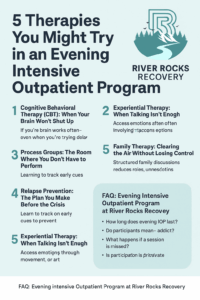
3. Relapse Prevention: The Plan You Make Before the Crisis
Here’s the truth: you don’t need to hit a rock bottom to benefit from relapse prevention therapy.
In fact, high-functioning clients often face a different kind of relapse risk—one that hides behind busy schedules and competent facades. Maybe you’ve tried to cut back already. Maybe it worked—until it didn’t.
Relapse prevention in evening IOP focuses on early cues, not dramatic consequences:
- Emotional relapse: irritability, isolation, overworking
- Mental relapse: bargaining, justifying, romanticizing the substance
- Physical relapse: when the action finally happens
You’ll learn to track the earlier stages, interrupt them gently, and build a plan that fits your life—business dinners, solo hotel nights, PTA meetings and all.
This isn’t about perfection. It’s about direction.
4. Experiential Therapy: When Talking Isn’t Enough
Some things you can’t explain logically. Especially the parts of yourself that use, even when you “know better.”
That’s where experiential therapy comes in. These sessions use movement, role play, art, or guided visualization to bypass your brain’s defenses and access the emotional body.
One client realized through drawing exercises that they felt safest during their evening glass of wine—not because of the alcohol, but because it was the only time no one needed anything from them.
That insight shifted everything.
Experiential therapy gives your subconscious room to speak—and teaches your conscious self how to listen.
5. Family Therapy: Clearing the Air Without Losing Control
If you’re holding it together externally, chances are you’ve also been holding tension at home. Conversations go unsaid. Resentment simmers. Sometimes the people closest to you feel the most shut out.
Evening IOP makes space for structured family therapy without overwhelming your schedule. These sessions aren’t blame-fests. They’re boundary-setting, role-repairing, expectation-resetting conversations with a trained therapist present. The benefits of outpatient treatment often include this kind of flexibility, allowing individuals to receive structured care while still maintaining work, family, and daily responsibilities.
They help partners say what they’re afraid of. Help parents stop walking on eggshells. Help you stop pretending everything’s fine when it clearly isn’t.
Sometimes just having the conversation is the change.
What Makes Evening IOP Different?
Most of our evening IOP clients aren’t in crisis. Not in the way people expect. They’re working. Parenting. Hiding.
For many individuals, emotional flatness after sobriety can make it difficult to feel connected or motivated, even when life appears stable on the surface.
They don’t need a total life overhaul—they need a lifeline that respects their complexity.
Evening sessions run after traditional work hours, giving you access to:
- Group therapy that doesn’t conflict with work
- Individual sessions scheduled with flexibility
- Support that fits into real life—not some idealized version of it
If you’re wondering whether you really need this, that might be the first sign that you do.
FAQ: Evening Intensive Outpatient Program at River Rocks Recovery
If cravings escalate, knowing what a relapse during an intensive outpatient program means can ease the fear.
How long does evening IOP last?
Our evening IOP typically runs 3–5 days per week for 6–12 weeks, depending on your needs. Sessions are usually held in the early evening to accommodate work and family schedules.
Do I have to call myself an addict to participate?
No. We don’t require labels. If you’re struggling with substance use, burnout, or emotional overload—and you want help—we’re here. You get to define your experience.
What if I miss a session?
Life happens. If you miss a session, we’ll work with you to make it up when possible. The goal isn’t punishment—it’s progress.
Is this private? Will my employer or anyone else know?
Your participation is completely confidential. We do not disclose attendance or treatment details to anyone without your written consent.
Can I join if I live outside Middletown?
Yes. We regularly welcome clients from nearby areas like West Chester and Monroe, Ohio. Evening scheduling makes it easier for people across the region to attend.
You’re Not Broken—You’re Tired
The cracks don’t have to show for you to seek support. Evening IOP exists for the person who’s still “doing fine” on the surface—but feels like they’re fading underneath.
Call (888) 905-6281 or visit to learn more about our Intensive Outpatient Program services in Middletown, Ohio.