

Even if you’ve been doing therapy or showing up to meetings, something can still feel…unfinished. You might wonder if IOP is just “more of the same” or if it could help in a way those other supports haven’t.
At River Rocks Recovery’s IOP in Middletown, Ohio, we see people every day who’ve asked that same question—and found real clarity in the answer. Sometimes, IOP becomes the missing link that turns scattered pieces of recovery into a steady path forward.
1. Structure You Can Lean On
Weekly therapy can be valuable, but it’s often just one hour in an otherwise unpredictable week. Twelve step meetings might happen daily, but they’re drop-in and self-led—you decide if you go, and you decide when you leave.
IOP is different because it gives you a clear, non-negotiable structure for several hours, multiple days a week. You know when to show up, what you’ll be doing, and who you’ll be with. It’s like having a standing appointment with your best chance at progress.
For many people who’ve stepped away from treatment before, that set schedule feels like a safety net. It keeps you from falling too far before someone notices and checks in.
2. A Blend of Professional Guidance and Peer Connection
In a typical therapy session, it’s just you and your therapist. In meetings, it’s you and peers—often with no professional facilitation.
In IOP, you get both. Licensed clinicians guide the process, making sure discussions stay focused and skills are learned. At the same time, you’re surrounded by people who “get it” on a personal level. You might be practicing a coping skill alongside someone who’s been through a similar struggle, which makes the learning feel less like homework and more like real life.
One client put it this way:
“In therapy, I talk. In meetings, I listen. In IOP, I learn and practice—and that’s what I needed most.”
3. Skills You Practice, Not Just Hear About
Therapy can help you understand why you react the way you do. Meetings can give you stories and wisdom from others. Both are valuable, but neither always gives you structured space to practice those skills while someone is there to guide you.
In IOP, roleplays, guided exercises, and feedback are built into the schedule. You don’t just hear about boundary-setting—you try it in a safe space. You don’t just learn breathing techniques—you actually do them together, with a counselor making sure you’re using them correctly.
That practical, hands-on approach makes it easier to transfer those skills into the moments that count: stressful phone calls, unexpected triggers, or the middle of a hard day.
4. More Eyes on Your Progress
When you’re in IOP, you’re not going through it alone. For individuals still understanding a partial hospitalization program, this level of consistent monitoring and support is one of the key similarities shared with more structured treatment options. Multiple professionals—therapists, group facilitators, case managers—are paying attention to your progress. If you seem more withdrawn or miss a session, someone will check in.
That’s a big difference from therapy or meetings, where missed attendance can easily slip by unnoticed. In IOP, you’re part of a team effort, and your growth is something people are actively tracking and supporting.
For some, that can feel like accountability. For others, it’s simply knowing you matter enough for someone to notice.
5. A Safe Place to Re-Enter if You’ve Stepped Away
If you’ve left a program before, you might feel like you have to explain yourself before you can come back. That fear of being questioned—or worse, judged—can keep people away for months or even years.
At River Rocks Recovery, our philosophy is simple: you’re welcome back. Period. Whether you’ve been gone two weeks or two months, we’re here to meet you where you are, not where we wish you’d been.
If you’re looking for IOP in Hamilton, Ohio or other nearby areas, our local services make it easy to return without feeling like you’re starting over from scratch.
6. A Bridge Between Inpatient and Everyday Life
Residential treatment can be a powerful reset, but re-entering daily life afterward is a challenge. Without enough structure, it’s easy to slip back into old patterns.
IOP is designed to bridge that gap. You keep building skills, but you also start practicing them in the real world—going to work, managing your home, and navigating relationships while still having strong support in place.
Even if you haven’t done inpatient treatment, IOP can still be the “middle ground” between total independence and full-time care. It’s intensive enough to help you make real progress but flexible enough to fit into your life. The intensive outpatient recovery experience often helps people understand how structured support, therapy, and accountability come together in a real-world setting without requiring full residential care.
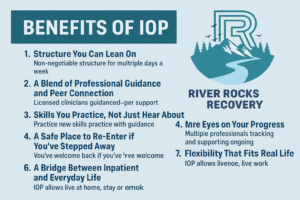
7. Flexibility That Fits Real Life
Unlike inpatient care, IOP lets you live at home, keep your job, and stay connected to family responsibilities. For many people, that’s the only way treatment is possible.
We work with your schedule to make sure you’re getting enough hours for meaningful progress without forcing you to give up your income, housing, or caregiving duties. That balance often makes it easier to commit fully—because you don’t have to choose between recovery and your real life.
Mini Comparison Table: IOP vs. Therapy vs. Meetings
| Feature | IOP | Therapy | Twelve Step Meetings |
|---|---|---|---|
| Frequency | 3–5 days/week | 1x/week | As often as you choose |
| Length of Session | 2–4 hours | 45–60 mins | 1 hour |
| Led By | Licensed clinician | Licensed clinician | Peer volunteers |
| Focus | Skills + support | Insight + coping | Peer connection |
| Accountability | High | Moderate | Low |
| Peer Interaction | Built-in | None | High |
| Flexibility | Moderate | High | High |
Frequently Asked Questions About IOP
Is IOP the same as outpatient therapy?
Not quite. Outpatient therapy usually means one hour a week with a therapist. IOP involves multiple hours, multiple days a week, and includes both group and individual therapy. It’s more structured and intensive.
Do I have to choose between IOP and meetings?
No. Many people do both. Meetings can give you a sense of community and ongoing peer support, while IOP gives you professional guidance and targeted skill-building.
What if I can’t commit to every IOP session?
We understand life happens. Missing an occasional session isn’t the end of the world. What matters is staying connected and communicating with your care team so adjustments can be made.
Can I rejoin IOP if I’ve dropped out before?
Yes. At River Rocks, we don’t hold absences against you. We welcome clients back whenever they’re ready, without demanding explanations.
How long will I need IOP?
Length varies. Some people benefit from a few weeks, others from several months. Your treatment plan will be adjusted as you progress.
Why This Matters If You’ve Left Before
Stepping away from treatment can stir up guilt. You might replay the last day you attended or avoid calling because you’re worried the conversation will be awkward.
The truth is, it doesn’t matter how long you’ve been away. What matters is deciding to come back now. IOP isn’t about judging your past—it’s about giving you the tools and support to shape your future.
A Gentle Invitation
If therapy and meetings haven’t been enough—or if you’ve been away from treatment and aren’t sure how to return—IOP might be the steady, structured support you’ve been missing.
Call (888) 905-6281 to learn more about our IOP services in Middletown, Ohio. You don’t have to explain your past absences—you’re welcome here.