

There’s a specific kind of silence that can settle in after a relapse.
Not chaos. Not always disaster. Sometimes it’s just quiet avoidance. Missed calls. Half-truths. That heavy feeling in your chest when you realize you’re starting to disappear from yourself again.
For a lot of alumni, coming back to care isn’t about “hitting bottom.” It’s about recognizing the feeling before things fully unravel. At River Rocks Recovery, we’ve seen people return to structured daytime support not because they failed — but because they remembered what life felt like before the spiral got deeper.
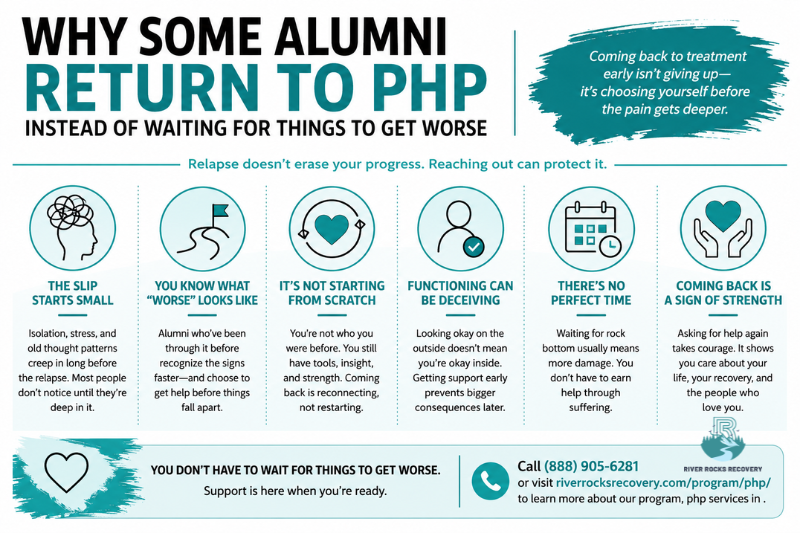
The Relapse Usually Starts Long Before the Substance
Most people don’t wake up one day and suddenly decide to throw everything away.
It’s usually smaller than that at first.
You stop answering texts. Meetings feel annoying instead of grounding. You tell yourself you’re just tired. Maybe you isolate a little more. Maybe your thoughts get louder at night. Maybe you start bargaining with yourself in ways that sound strangely reasonable.
A lot of alumni say the hardest part wasn’t the relapse itself. It was the shame that followed.
The voice that says: You already had your chance.
But relapse doesn’t erase the work you did. It doesn’t delete your growth. It doesn’t mean the version of you that fought hard for recovery was fake.
It means something started hurting again.
Some People Return Early Because They Know What “Worse” Looks Like
There’s a different kind of wisdom that comes after you’ve been through treatment once.
You recognize patterns faster.
You know what it feels like to slowly lose structure. You know how quickly “I’m fine” can turn into hiding bottles, skipping meals, ignoring loved ones, or waking up feeling disconnected from your own life.
That’s why some alumni come back before things completely collapse.
Not because they’re weak.
Because they’re paying attention.
There’s strength in interrupting the spiral early. Honestly, it can take more courage to ask for help at the beginning than after everything falls apart publicly.
Returning Doesn’t Mean Starting From Scratch
This is one of the biggest fears alumni carry.
People think returning to care means they’ve lost all progress. Like they’re back at day one emotionally, spiritually, socially.
That usually isn’t true.
You still know things now that you didn’t know before. Your body remembers recovery. Your nervous system remembers safety. Somewhere underneath the shame, there’s still a part of you that wants peace badly enough to reach for support again.
It’s important to challenge the myth of hitting rock bottom before recovery, as many people begin healing long before reaching a crisis point, and earlier support often leads to better outcomes.
Sometimes returning to treatment feels less like restarting and more like reconnecting to yourself before things get darker.
Like finding the trail again after wandering off it for a while.
The “Functional” Phase Can Be the Most Dangerous Part
One of the reasons people wait too long is because life still looks manageable from the outside.
You’re still working. Still parenting. Still showing up enough to convince yourself it isn’t serious yet.
But internally, things can already feel exhausting.
High-functioning relapse can be brutally lonely because nobody sees the panic underneath it. You may look okay while quietly bargaining with yourself every hour of the day.
That’s often where returning to a higher level of care can help stabilize things before the consequences become larger, more painful, or harder to undo.
For some alumni, concerns about work, family, or finances create hesitation too. Questions about partial hospitalization insurance coverage can keep people stuck in indecision longer than they should be. But getting clarity early often feels less overwhelming than carrying the fear alone.
There’s No “Perfect” Time to Come Back
People delay treatment because they think they need to fully crash first.
But waiting for undeniable proof usually means waiting for more damage. More broken trust. More physical exhaustion. More emotional isolation.
For many people, this stage can also overlap with dealing with emotional flatness after sobriety, where things feel numb or disconnected even without a full relapse.
You do not have to earn support through suffering.
If part of you already knows you’re slipping, that matters.
And if meth use has become part of the relapse cycle again, exploring treatment options in Methamphetamine Rehab may help you regain stability before things escalate further.
What Alumni Often Say After They Return
There’s a sentence we hear often from returning clients:
“I wish I had come back sooner.”
Not because treatment is easy.
Not because relapse feels small.
But because carrying it alone became heavier than asking for help again.
Coming back can feel awkward at first. Vulnerable. Humbling in a way that stings. But it can also feel like exhaling after holding your breath for months.
And nobody here expects perfection from you.
We expect honesty. Effort. Humanity. The messy middle that recovery sometimes actually is.
Relapse may change your path for a moment. It does not have to become your ending.
Call (888) 905-6281 or visit our php services to learn more about our program.