
I thought I was too functional for treatment.
I had a job. A calendar full of meetings. A gym membership I actually used. I made dinner, paid bills, cracked jokes, and kept the high-achiever mask securely in place.
Sure, I was drinking more than I wanted to—but wasn’t everyone?
So when a therapist suggested an intensive outpatient program, I laughed. That’s for people who’ve hit rock bottom, I thought. Not people like me.
But behind the scenes, I was unraveling. Quietly. Neatly. Just enough to notice.
And IOP didn’t take my life away. It finally gave me one worth staying present for.
I Didn’t Check the “Addict” Box—Until I Did
I kept a mental checklist of reasons I wasn’t that bad.
- I hadn’t lost my job.
- I wasn’t drinking in the morning (except on weekends).
- I didn’t black out often.
- I didn’t drive drunk (much).
That list helped me avoid the real one—the one with anxiety spirals, emotional isolation, and the exhausting game of maintaining appearances.
I wasn’t fine. I was functioning. Big difference.
IOP Was the First Place I Didn’t Have to Pretend
I assumed treatment would be humiliating. That I’d have to perform my pain or downplay my success to fit in.
Instead, I found a room full of people who were tired of pretending.
We weren’t all the same—but we were all there for the same reason: something wasn’t working, and we were done lying to ourselves about it.
The intensive outpatient program offered structure without suffocation. Three to five days a week. Flexible times. Real conversations. No pity. No performance.
It worked around my life—so I could finally work on my life.
I Thought Sobriety Would Make Me Boring
I used to think alcohol was the only thing keeping me interesting. The life of the party. The sharp wit in the group chat. The one who could handle anything.
But all it was really doing was keeping me disconnected—from myself, from others, from the moment I was in.
IOP helped me relearn connection.
Through group therapy, I started to understand how often I used humor to dodge pain. How I used work to avoid intimacy. How I used alcohol to delay facing the grief that had calcified inside me over years.
Sobriety didn’t flatten me. It freed me.
IOP Didn’t Derail My Career—It Protected It
Let’s be real: part of why I avoided treatment was fear of professional damage. I didn’t want to vanish. I didn’t want questions. I didn’t want to look “unwell.”
But here’s what happened: I started performing better. Not because I was trying harder—but because I stopped managing an invisible crisis in the background of every task.
I was clearer. Sharper. I stopped second-guessing every decision. I was less reactive. More present. The fog lifted.
I didn’t tell everyone at work. I didn’t have to. The difference spoke for itself.
If I’d found an intensive outpatient program in Dayton, Ohio sooner, I might’ve started healing before the burnout got that deep. That proximity matters when you’re hanging by a thread but still showing up.
Recovery Didn’t Make Me Soft—It Made Me Real
I thought healing would mean losing my edge. I thought it would dull the fire that made me… me.
What I didn’t realize was how much of my “edge” came from pain. Anxiety. Hypervigilance. Old trauma I hadn’t dealt with because I was too busy being successful.
IOP didn’t erase my intensity. It gave it direction.
Now I use that energy to build a life that fits, not one I have to escape from every Friday night.
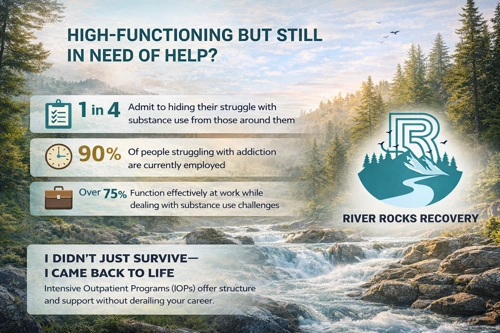
I Didn’t Just Survive—I Came Back to Life
People ask me what the biggest change was.
It wasn’t the tools—though they helped.
It wasn’t the group—though that cracked me open.
It was this: I stopped performing healing and started experiencing it.
IOP taught me that I didn’t have to be all better to be worthy of support. I didn’t have to implode to deserve help. I didn’t have to self-destruct to start over.
And when I moved closer to Monroe, Ohio, I realized how many others were navigating the same high-functioning burnout I had. That illusion of “fine” is everywhere—and so is the need for real, flexible support.
FAQs: High-Functioning but Still in Need
Can I be in IOP and still work full-time?
Yes. Many IOPs offer morning, evening, or weekend tracks to accommodate professionals, parents, and people with full schedules.
What if I don’t feel “bad enough” for treatment?
If you’re reading this, you’re already asking important questions. You don’t need a rock bottom to get help—just a desire for change.
Will I be with people who’ve had totally different experiences than me?
Probably—and that’s often where the best insight comes from. You’ll be surprised how much common ground there is across different types of struggle.
What if I’ve already tried therapy and it didn’t work?
IOP is more immersive than individual therapy. It combines multiple approaches—group support, psychoeducation, skills training—that often reach deeper than one-on-one alone.
Do I have to stay forever?
No. Most IOP programs are time-bound, often lasting 6–12 weeks. You and your care team decide together when you’re ready to step down—or step forward.
You don’t have to fall apart to deserve help.
Call (888) 905‑6281 to learn more about our intensive outpatient program in Middletown, Ohio.