
It’s the ache of waiting for a reply. The ping that doesn’t come. The way you tell yourself not to panic, even though your stomach already knows: they’re using again.
If you’re here, you’re probably scared. Maybe tired. Maybe both.
And you’re not alone.
We’re a group of parents who’ve sat where you’re sitting—staring down relapse, wondering if there’s anything left to try. Someone mentioned a partial hospitalization program, and we did what you’re doing now: Googled it in the middle of the night, hoping for answers. Or at least, for something that made sense.
This blog is what we wish someone had handed us then.
What Is a Partial Hospitalization Program (PHP)?
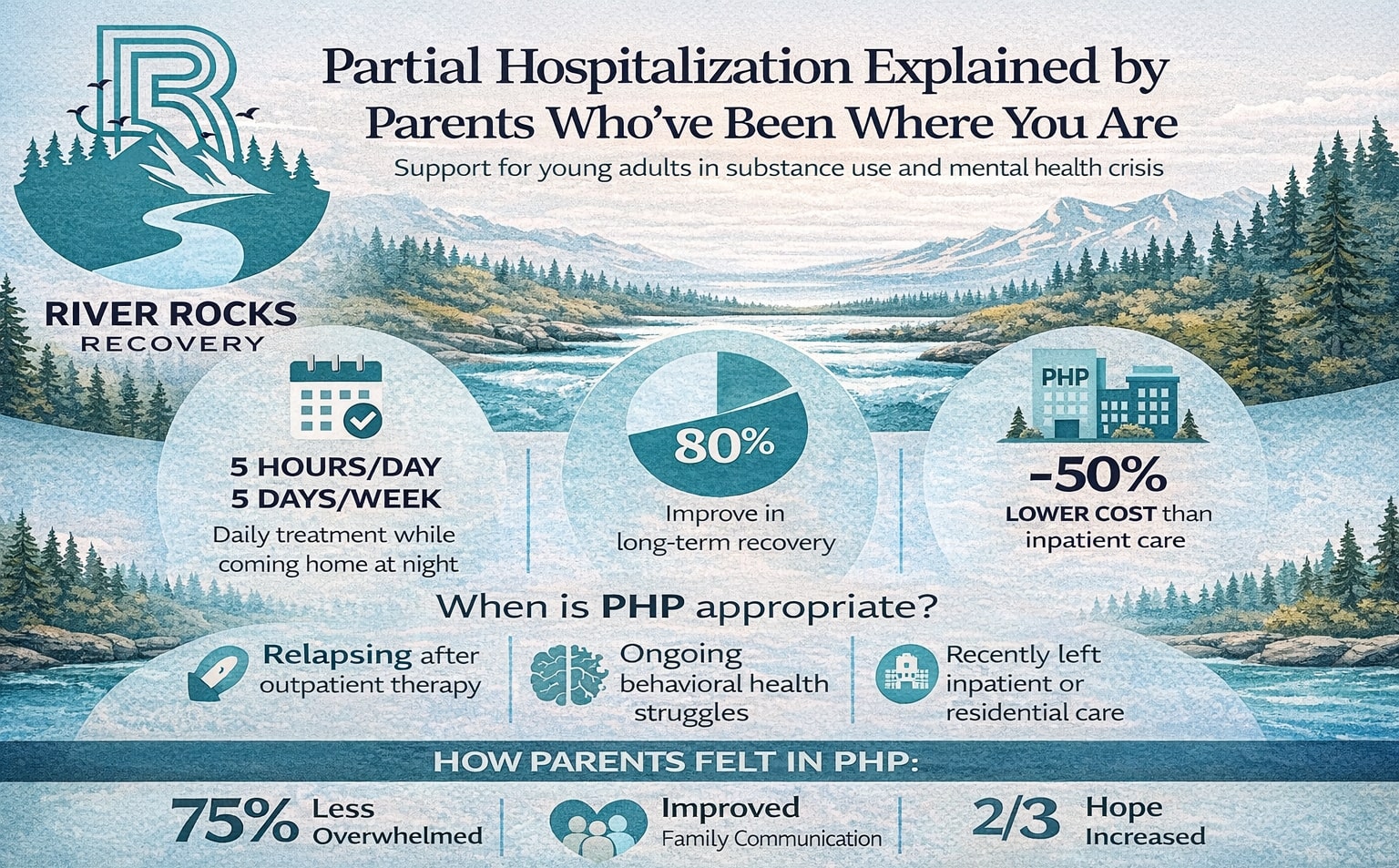
First things first: no, it doesn’t mean your child has to go back to the hospital. Despite the name, a partial hospitalization program is a structured, intensive outpatient treatment program—usually running five to six hours a day, five days a week.
It’s for people who need more than once-a-week therapy, but who don’t need to stay overnight in a facility.
PHP is often the right fit when:
- Someone’s relapsed after trying outpatient therapy
- Mental health symptoms are interfering with daily functioning
- There’s been a crisis, but they’re stable enough to avoid inpatient care
- They’ve just discharged from residential treatment and need a step-down
You can read more about the clinical structure of River Rocks’ partial hospitalization program here.
But what made it work for us wasn’t just the schedule. It was the way our kids were seen—not as problems to fix, but people worth investing in. People in pain who were finally offered something deeper than surface solutions.
“They Tried Therapy—It Didn’t Work.” We Said That Too.
So many of us had already gone down the therapy path. Weekly sessions. Textbooks stacked on nightstands. Co-pays. “Progress” charts. But nothing shifted in a lasting way.
One mom put it best:
“Therapy helped… until the second they left the office. Then it was right back to spiraling.”
What PHP gave our kids was immersion. For families wondering what is a partial hospitalization program, this kind of daily structure and hands-on support is often what makes PHP effective during early recovery. Not just a conversation—but repetition. Practice. Accountability. Real, daily chances to learn how to manage urges, repair relationships, and cope without substances.
What a Day in PHP Actually Looks Like
At River Rocks Recovery, here’s what a PHP day might include:
- Group therapy with peers—guided by trained clinicians who keep it honest but safe. These sessions dig into real topics: grief, trauma, family wounds, shame spirals, and coping tools.
- Individual therapy at least once a week with a primary clinician who actually knows your child’s story.
- Skill-building workshops on communication, distress tolerance, emotion regulation (hello, DBT), and more.
- Case management—someone who helps coordinate outside needs like medical care, housing support, or job-readiness if needed.
- Optional family support—where you can join sessions, ask questions, and begin healing your own wounds.
There’s a rhythm to PHP. And for our kids, that rhythm became regulation.
“But They Don’t Want Treatment.” Neither Did Ours (at First)
If your 20-something is resistant, you’re not failing.
One of the hardest things about young adult treatment is the illusion of choice. They’re legally adults—but emotionally stuck. They’ll say they’re fine. Say they don’t need help. Sometimes they storm out. Sometimes they just ghost.
We know how that feels. The line between letting go and giving up feels razor-thin.
But here’s what we learned: you don’t need them to be enthusiastic. You just need them to show up. PHP meets them in their resistance. Not with lectures—but with real talk, consistency, and peer support that often works better than anything we could’ve said as parents. For many families, choosing a partial hospitalization program after detox can provide the structure and support needed to help teens stay engaged in recovery even when they’re resistant to treatment.
How River Rocks Helped Us Breathe Again
At River Rocks, we weren’t treated like overbearing parents. We were treated like people who loved someone in pain.
We got updates that were honest, not just “positive spins.” We were offered education, not just rules. We learned how to hold boundaries without withdrawing love. That was huge.
“One night, our son told us, ‘I actually feel better when I’m there.’ That was the first time we exhaled in months.”
— Parent of a PHP client, 2023
When Is PHP Not the Right Fit?
PHP isn’t a catch-all. If your child is:
- Still actively detoxing or medically unstable
- In danger of harming themselves or others
- Completely unwilling to attend any treatment
…then a higher level of care might be needed first. River Rocks is great at assessing fit. They won’t push a program that isn’t right.
But for many families like ours—kids who are struggling, cycling, stuck, but not fully gone—PHP was the first real foothold.
The Guilt. The Grief. The Quiet Hope.
We know the guilt that comes with asking for more help.
We know the grief that whispers, “Why didn’t this work the first time?”
And we also know this: You are not failing. You are loving. And love sometimes looks like boundaries, new plans, and letting someone else step in.
For many families, finding balance in a PHP program becomes an important part of learning how to support recovery while still maintaining healthy family roles and emotional stability.
PHP gave us space to be parents again—not detectives, not rehab coordinators, not emotional punching bags. Just parents. Loving, flawed, trying.
And for our kids, it planted seeds. Some sprouted quickly. Some took months. But they were real.
Struggling with substance use tied to methamphetamine? Explore care in Methamphetamine Rehab for more targeted support. Explore our services and discover safe ways to process your memories. Recovery in West Chester, Hamilton, Monroe, and Dayton begins with support that truly understands.
Frequently Asked Questions About PHP for Parents
What if my child doesn’t want to go to PHP?
It’s common for young adults to resist structured treatment. Many begin PHP with low motivation—and still benefit. The routine, peer connection, and therapeutic support often help shift resistance over time.
Can they work or go to school during PHP?
PHP is a full-time commitment during the day, so most clients take a temporary break from work or school. That said, it’s short-term. The goal is to stabilize, heal, and return stronger.
Is it covered by insurance?
Often, yes. PHP is usually covered by many commercial insurance plans. River Rocks can help you verify benefits before your child begins.
How is PHP different from IOP?
PHP is more intensive. It typically runs 5 days/week for 6 hours/day. IOP (Intensive Outpatient) is usually 3–5 days/week for 3 hours/day. If your child needs more structure, PHP is likely the better starting point.
Will I get updates as a parent?
Yes—with your child’s consent, clinicians can include you in care planning and progress updates. Family involvement is encouraged and supported.
You’re Not Alone. We’re Here.
Call (888) 905-6281 or visit to learn more about our partial hospitalization program services in Middletown, Ohio.
There’s still a way forward—even if this isn’t the first try. Let us help you find your breath again.