

There’s a moment a lot of people never talk about. Not the dramatic movie version. Not rock bottom. Just a quiet thought in the middle of an ordinary day:
“I don’t think I want to keep doing this anymore.”
For many people in Ohio, that thought comes long before they’re ready to disappear for 30 days or call themselves “an addict.” It’s often less about crisis and more about exhaustion. Hiding pills. Running low early. Feeling anxious without them. Wondering if life has slowly started revolving around something you never meant to depend on.
The good news is that getting help doesn’t always mean putting your entire life on hold. Some people begin recovery through flexible support like opiate rehab treatment while still living at home, working, or caring for family.
Start by Being Honest About What’s Actually Happening
A lot of people spend months trying to answer the wrong question.
They ask:
- “Am I bad enough?”
- “Do I really qualify for help?”
- “Would other people think this counts as addiction?”
A better question might be:
- “Has this started taking more from me than it gives?”
You don’t have to hit a catastrophic bottom to notice something feels off.
Maybe you’re taking more than prescribed. Maybe stopping suddenly makes you feel sick, restless, or emotionally shaky. Maybe the pills became less about pain relief and more about getting through the day without feeling uncomfortable.
If you’re beginning to question your relationship with a substance, learning how to get sober successfully can provide guidance on taking safe, sustainable steps toward recovery and long-term well-being.
That awareness matters. Quiet awareness still counts.
Don’t Try to White-Knuckle Withdrawal Alone
Many describe the quiet moment after a diagnosis — and what comes next matters most.
This is one of the biggest misconceptions people carry.
They assume the only two options are:
- Keep using
- Lock yourself away somewhere for a month
But there’s a middle ground many people never hear about.
Trying to quit opioids completely alone can become physically and emotionally overwhelming fast. Symptoms like nausea, sweating, insomnia, anxiety, body aches, and cravings can push people right back into using — not because they’re weak, but because the body is fighting hard to regain balance. Using opiate relapse prevention strategies can help individuals manage cravings, reduce triggers, and build a more stable path toward long-term recovery.
That’s why many people begin with structured support instead of isolation.
For some, that means talking with professionals about flexible recovery options or exploring care that fits around real life instead of replacing it entirely.
Recovery Doesn’t Have to Look Like Disappearing From Your Life
This is often the biggest fear for sober-curious people.
You may have a job. Kids. Bills. Parents depending on you. You may not feel ready for live-in treatment or intense disruption. That hesitation is more common than you think.
Some people in Middletown and nearby communities start with support that allows them to:
- Sleep at home
- Keep working when appropriate
- Attend therapy several days a week
- Build recovery gradually instead of all at once
The goal isn’t to punish you. It’s to help you stabilize safely and rebuild trust with yourself.
And honestly? Sometimes the bravest thing isn’t blowing up your whole life overnight. Sometimes it’s simply letting someone help you carry the weight.
Taking that first step often begins with learning more about how substances affect overall health, including the impact of alcohol on arthritis and other long-term physical conditions that can be worsened by ongoing alcohol use.
Sometimes support starts with information. Other times, it starts with reaching out.
Pay Attention to the “Small” Signs Your Relationship With Pills Has Changed
Dependence doesn’t always arrive loudly.
Sometimes it looks like:
- Counting pills more often than you’d like to admit
- Feeling panic when a refill is delayed
- Taking medication differently than intended
- Thinking about quitting constantly — but never feeling ready
- Feeling emotionally flat without them
- Promising yourself each week you’ll cut back “soon”
These moments can feel small individually. Together, they tell a story.
A lot of people searching for outpatient opioid treatment near me aren’t looking for labels. They’re looking for relief. They want their mind back. Their energy back. Their relationships back.
That desire matters.
You’re Allowed to Explore Help Before Things Get Worse
This part is important.
You do not need to “prove” you deserve support.
You don’t have to wait for an overdose, job loss, arrest, or public collapse. Early intervention often gives people more options, not fewer.
And if opioids aren’t the only thing involved, it may help to explore broader support options too, including care for stimulant use or other substances. Some people discover they need additional help in methamphetamine rehab after realizing multiple substances have quietly become part of coping.
Recovery conversations can start small. One phone call. One honest admission. One question you’ve been scared to ask out loud.
That’s enough to begin.
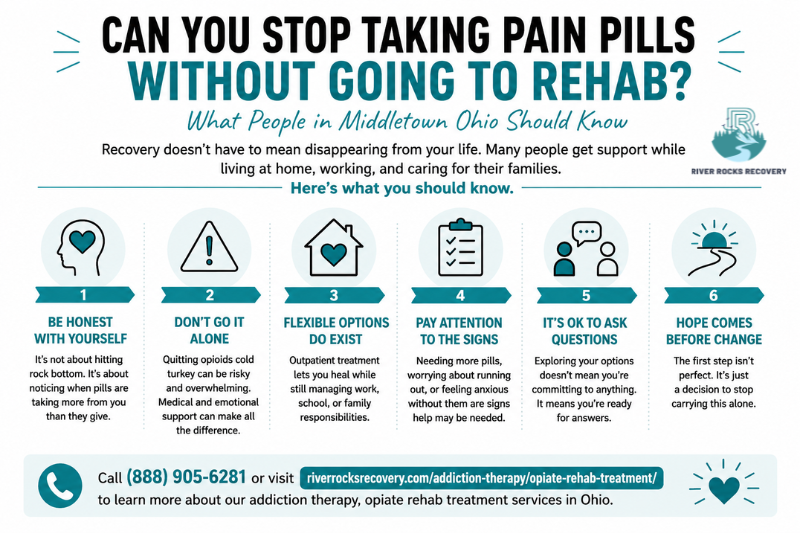
The First Step Usually Feels Less Dramatic Than People Expect
People often imagine recovery starts with certainty.
It usually doesn’t.
More often, it starts with:
- “I can’t keep doing this.”
- “I’m tired.”
- “I don’t know what I need yet, but I know something has to change.”
You don’t need to have your entire future figured out before reaching out.
You just need enough willingness to stop carrying this alone for one more day.
Call (888) 905-6281 or visit our addiction therapy and opiate rehab treatment services to learn more about addiction therapy and opiate rehab treatment options available in Ohio.