

Your child is still your child.
Even if they’re distant.
Even if they’re angry.
Even if you barely recognize the version of them standing in front of you.
When parents begin searching for opiate addiction treatment, it’s rarely casual. It’s usually 2 a.m., and something has scared them enough to finally type the words.
If that’s you, take a breath.
You’re not overreacting. And you’re not too late.
The Brain Under Opioids: What’s Actually Happening
Opioids don’t just “relax” someone. They alter the brain’s communication system.
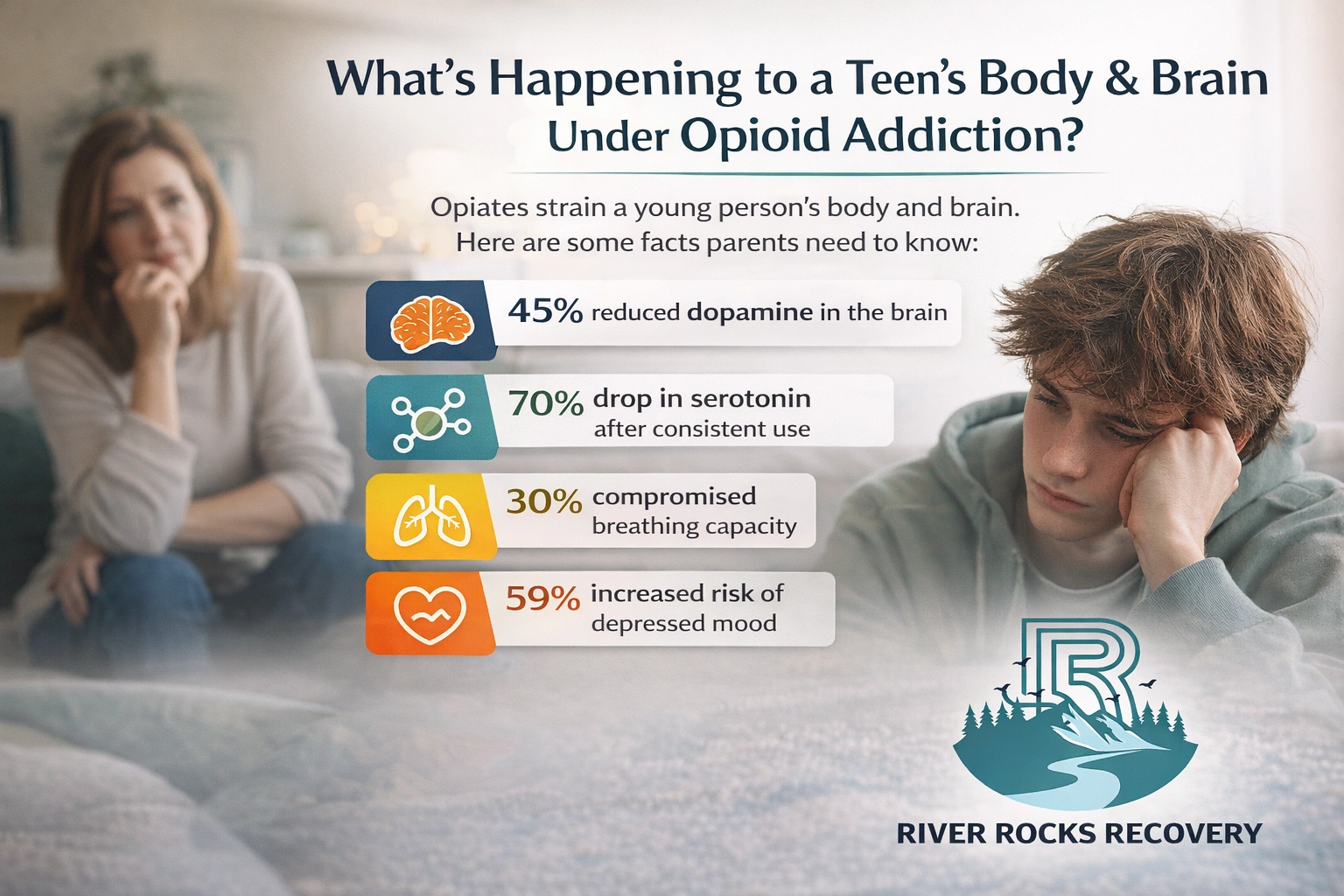
Over time, repeated opioid use reduces natural dopamine production. Dopamine is what helps us feel pleasure, motivation, and connection. When it drops, everyday life starts to feel flat or unbearable without the substance.
Your child may seem:
- Unmotivated
- Emotionally numb
- Irritable or reactive
- Detached from goals they once cared about
This isn’t laziness. It’s neurological disruption.
The brain adapts to survive. When opioids are present regularly, the brain adjusts its chemistry around them. That adaptation is powerful—but it’s not permanent when support begins.
The brain is under stress. It is not beyond repair.
Why Young Brains Are Especially Vulnerable
The brain continues developing into the mid-20s.
That means two things:
- It’s more sensitive to disruption.
- It’s also more capable of recovery.
Executive functioning—the ability to plan, regulate emotion, assess risk, and delay gratification—is still forming in young adults. Opioids interfere with these processes.
You may notice impulsive decisions, risky behavior, or extreme emotional swings. These changes can be frightening.
But here’s the part many families don’t hear enough: with early intervention, the brain can recalibrate. Neural pathways can strengthen again. Emotional regulation can return.
Time matters. But so does action.
The Body Is Signaling Distress
Addiction doesn’t stay in the brain.
Opioid use can affect:
- Breathing patterns
- Sleep cycles
- Hormone balance
- Digestive function
- Immune response
You might see physical changes—weight loss, constant fatigue, unusual sleep hours, frequent illness.
The body swings between intoxication and withdrawal. That constant cycle is exhausting for every organ system.
Stabilizing the body through structured care protects it from repeated shock. When the body steadies, the brain can begin healing instead of constantly reacting.
They recover together.
Withdrawal Is More Than “Feeling Uncomfortable”
One of the most dangerous misunderstandings is minimizing withdrawal.
Withdrawal can include:
- Severe anxiety
- Depression
- Muscle and bone pain
- Nausea and insomnia
- Intense cravings
To the brain, withdrawal feels like a threat. The stress response surges. Survival mode activates.
Without medical oversight, many young adults return to use simply to stop the distress. That cycle increases risk dramatically.
Medically supervised stabilization reduces this shock to the system. It protects the body while reducing the neurological chaos that fuels relapse.
This isn’t about making things easy.
It’s about making things safer.
Structure Is Neurological Protection
When addiction takes hold, routine collapses.
Sleep becomes irregular. Meals are skipped. Responsibilities fall apart. Social circles shift.
Structured daytime care or multi-day weekly treatment rebuilds rhythm.
Regular therapy. Predictable schedules. Healthy sleep patterns. Balanced nutrition.
The brain thrives on rhythm. Consistency lowers stress hormones and supports emotional regulation.
Think of structure as scaffolding around a building under repair. It doesn’t rebuild everything overnight—but it prevents further collapse while healing begins inside.
For families in West Chester, Ohio, accessing structured care early can mean the difference between continued neurological strain and meaningful stabilization.
When Mental Health and Substance Use Collide
Many young adults using opioids are also struggling with anxiety, depression, trauma, or other mental health concerns.
Sometimes the opioid use started as self-medication. Sometimes mental health symptoms intensified after use began.
Either way, treating only one layer leaves vulnerability exposed.
Comprehensive support addresses the full picture—especially when mental health and substance use collide. If additional substances are involved, families may explore options such as care in Methamphetamine Rehab to ensure nothing is left untreated.
Your child is not just a diagnosis. They are a developing human under strain.
The Myth of “They Have to Hit Rock Bottom”
Parents are often told to wait.
To let consequences teach the lesson.
To stop rescuing.
To let them “want it enough.”
But waiting while the brain and body remain under stress carries real risk.
Rock bottom is not a medical strategy.
Early intervention protects cognitive function, emotional development, and physical health. It interrupts the cycle before long-term damage compounds.
Hope does not require collapse.
What Recovery Actually Protects
When families pursue opiate addiction treatment early, they are protecting:
- Memory and attention
- Emotional resilience
- Lung and heart health
- Academic and career trajectory
- Long-term mental wellness
Addiction narrows life. Recovery widens it again.
Parents in Dayton, Ohio often tell us they feared the worst-case scenario for months before reaching out. The relief they feel after having a plan—after knowing there’s a path forward—can be immediate.
Not because everything is fixed overnight.
But because they are no longer standing still.
You Are Not the Cause
In crisis, parents turn inward.
“What did I miss?”
“Did I push too hard?”
“Was I too soft?”
Addiction is shaped by genetics, environment, trauma exposure, peer influence, and neurobiology. Parenting is only one piece of a complex puzzle.
Blame doesn’t protect your child.
Information and action do.
What Happens When You Reach Out
Many parents expect judgment.
They brace for criticism or lectures.
Instead, you’ll find calm.
When you contact us, the first step is conversation. We ask about what you’re seeing. We listen. We clarify options. We help you understand what structured care could look like.
There is no pressure to commit on the spot.
There is only a plan built around safety.
FAQs Parents Ask When They’re Afraid
Can opioid use permanently damage my child’s brain?
Long-term use can impact brain function, but early and consistent treatment increases the likelihood of significant recovery. The brain’s ability to adapt—especially in young adults—is powerful.
How quickly does the body begin healing?
Some stabilization begins within days under proper medical supervision. Sleep improves. Appetite returns. Anxiety may decrease. Deeper neurological repair takes time, but early changes can be noticeable.
What if my child refuses help?
Resistance is common. We guide families on how to approach conversations without escalating defensiveness. Even preparing yourself now strengthens your ability to respond when your child is ready.
Will treatment change who my child is?
The goal is restoration, not transformation. Treatment aims to reduce neurological chaos so your child’s authentic personality can re-emerge without chemical interference.
Is it too late if they’ve been using for years?
It is not too late. While prolonged use increases risk, the brain remains capable of recovery. Intervention at any stage is protective compared to continued use.
What if they relapse?
Relapse can occur in recovery. Treatment reduces frequency and severity while increasing safety. The focus is progress and protection—not perfection.
The Hard Truth — And the Hope
Opioids strain the brain. They strain the body. They strain families.
But treatment protects.
It lowers neurological stress.
It stabilizes the body.
It rebuilds emotional regulation.
It restores possibility.
Your child’s brain is still capable of healing.
Your child’s body is still capable of stabilizing.
Your family is still capable of rebuilding.
You don’t need certainty to act.
You need courage—and support.
If you’re ready to explore what protection and recovery could look like for your child, we’re here to help.
Call (888) 905-6281 to learn more about our opiate addiction treatment in Middletown, Ohio.