


I’ve heard it more times than people usually admit out loud:
“I already tried this. It didn’t work.”
And underneath that thought is something heavier—something quieter:
“So what’s the point of going back?”
If that’s where you are, this isn’t about convincing you. It’s about being honest with you.
Because what you’re feeling makes sense. But it’s also not the full picture.
If you want to see what support can actually look like from here, you can explore options that meet you where you are—but first, let’s talk about what this moment really means.
It Felt Like It Worked… Until It Didn’t
That’s the part that messes with people.
If it had never worked at all, it would be easier to dismiss. But it did work—at least for a while.
You might remember:
- Feeling clearer than you had in months
- Having routines that made sense
- Finally getting a break from the noise in your head
That wasn’t fake.
But when things started slipping again, it can feel like all of that was temporary—or worse, pointless.
It wasn’t.
It just wasn’t fully supported long enough to hold.
Relapse Doesn’t Mean You Lost Everything
It feels like it does.
Like everything you learned, everything you built, just disappeared.
But that’s not actually how it works.
You still carry:
- Awareness of your patterns
- Recognition of your triggers
- Memory of what it felt like to be steady
Those things don’t vanish. They just get harder to access when you’re back in old habits.
Coming back isn’t about relearning everything.
It’s about reconnecting to what you already know.
The Problem Wasn’t That You Didn’t Try
Most people who relapse didn’t “half-try.”
They gave real effort.
They showed up. They listened. They tried to apply what they learned.
So when things fall apart again, it’s easy to turn that into:
“I must be the problem.”
But more often, the issue isn’t effort—it’s support matching reality.
Life outside of structure is unpredictable. Stress shows up differently. Old environments come back into play.
And if the level of support doesn’t match that reality, things can start to unravel.
That’s not failure. That’s a mismatch.
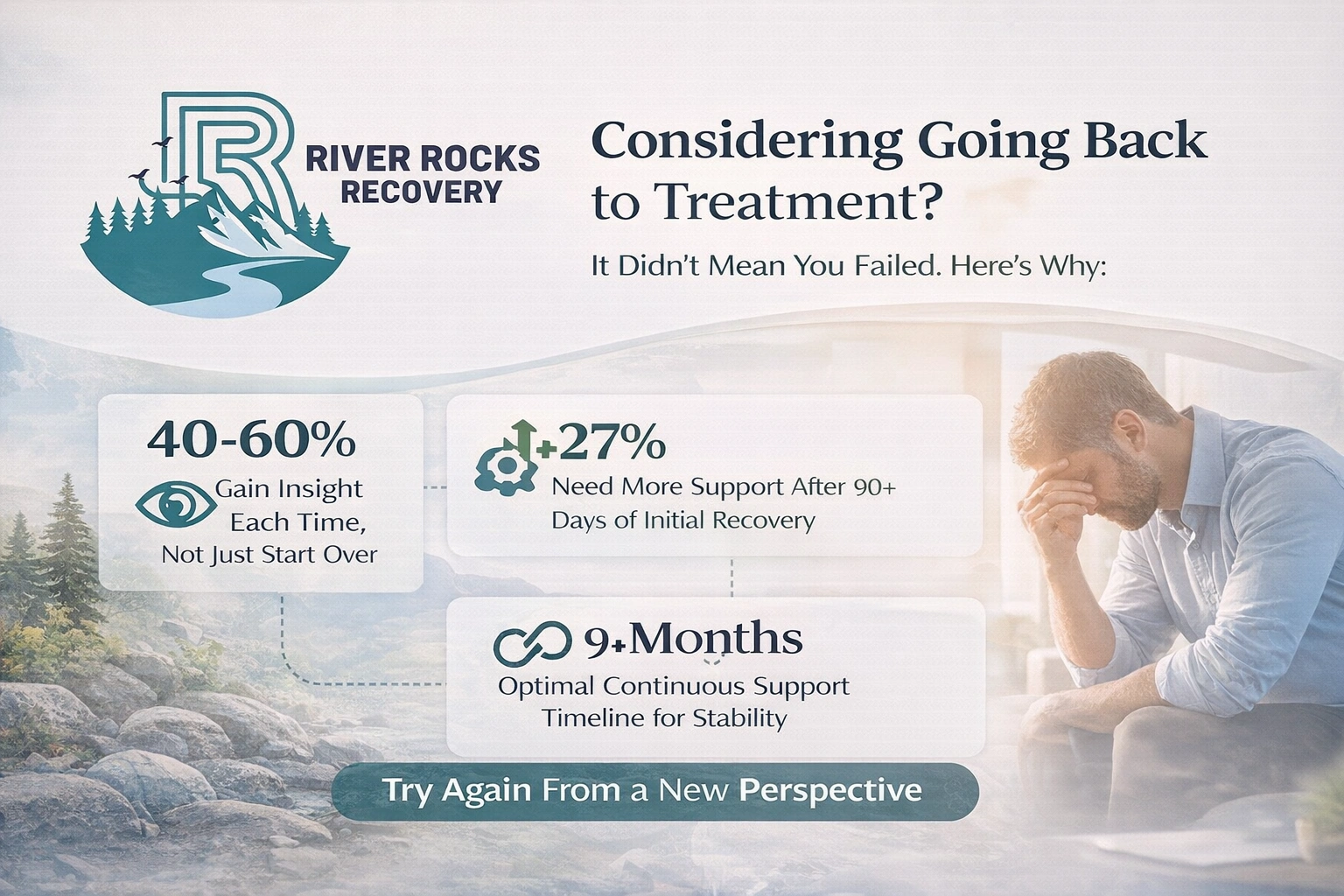
That Voice Saying “Why Go Back?” Isn’t Random
It’s coming from somewhere real.
You’re tired.
Tired of trying.
Tired of hoping.
Tired of feeling like you’re repeating the same cycle.
So your brain does what it thinks is helpful—it tries to protect you from more disappointment.
It says:
“Don’t go back. It didn’t work last time.”
But here’s the problem with that logic:
It assumes nothing can be different.
And that’s not true.
You’re Not the Same Person You Were the First Time
This part matters more than people realize.
Even if it doesn’t feel like it, you’re different now.
You’ve seen what works—and what doesn’t.
You’ve experienced what support can feel like.
You’ve felt the contrast between stability and slipping.
That changes how you approach things.
The second time isn’t a repeat.
It’s a continuation—with more awareness.
You Might Have Stepped Away Too Soon
This is more common than people expect.
Things start feeling better, and the natural instinct is:
“Okay, I’ve got this now.”
So support gets reduced. Structure fades. Check-ins become less frequent.
And for a while, it feels fine.
Until it doesn’t.
Because the transition from structured support to full independence isn’t always smooth.
Some people need that middle layer longer than they think.
Not because they’re failing—but because real life is complex.
There’s a Difference Between Starting Over and Starting Deeper
This is where perspective shifts.
Starting over means you’re back at zero.
Starting deeper means you’re beginning again—but with insight you didn’t have before.
You know:
- Where things started to slip
- What warning signs looked like
- What kind of support actually helped
That’s not starting over.
That’s starting with data.
The Real Risk Isn’t Relapse—It’s Disconnection
Relapse gets all the attention.
But what usually leads to it is something quieter: disconnection.
Disconnection from:
- Support systems
- Honest conversations
- Structure that creates stability
Once that disconnect happens, it becomes easier for old habits to return.
And harder to reach out.
The goal isn’t perfection.
It’s staying connected—even when things aren’t going perfectly.
You Don’t Have to Go Back the Same Way
One of the biggest misconceptions is that going back means repeating the exact same path.
It doesn’t.
You can adjust:
- The level of support
- The type of structure
- The way you stay connected
For some people, especially those dealing with stimulant use patterns, it might mean exploring care in Methamphetamine Rehab as part of a more tailored approach.
It’s not about doing the same thing again.
It’s about doing what actually fits this time.
This Isn’t About Proving Anything
There’s often a pressure to “get it right” the next time.
To prove that you can do it.
That pressure can actually make things harder.
Because it turns recovery into a performance instead of a process.
You don’t have to prove anything.
You just have to stay honest about what you need.
If You’re Thinking About Going Back, That Means Something
People don’t usually consider returning unless something inside them remembers a different way of feeling.
Even if it was brief.
Even if it didn’t last as long as you hoped.
That memory matters.
It’s not weakness.
It’s awareness.
For Some, the Environment Matters More Than They Realized
Where you go—and how support is structured—can make a difference.
For individuals in areas like Dayton, Ohio, access to consistent, structured support can be the difference between trying to manage everything alone and having a system that actually holds.
And sometimes, just knowing that option exists changes how possible it feels to try again.
You’re Allowed to Try Again Without Calling It Failure
You don’t have to label this as starting over.
You don’t have to carry it as proof that something is wrong with you.
You can look at it as:
A pause.
A recalibration.
A moment where you noticed something wasn’t working—and decided to respond.
That’s not failure.
That’s awareness turning into action.
FAQs About Returning After Relapse
Does relapse mean treatment didn’t work?
No. It often means the level or duration of support didn’t match your needs long-term. The progress you made still matters.
Why does going back feel harder than the first time?
Because now you’re aware. You’ve seen what works, and that awareness can bring both clarity and pressure.
Am I just repeating the same cycle?
Not necessarily. Each time you return, you bring more insight into what you need and what didn’t work before.
How do I know if I need more support this time?
If things started to slip after structure was removed, it may mean you need a more gradual transition or longer support.
What if I feel ashamed to come back?
That’s one of the most common feelings—and also one of the biggest barriers. But coming back is not a setback. It’s a decision to re-engage.
You’re Not Back at the Beginning—You’re at a Choice Point
This moment isn’t about your past.
It’s about what you do next.
You can stay where you are and hope things stabilize.
Or you can respond to what you’re noticing.
Not perfectly. Not all at once.
Just honestly.
Ready to Take a Step Without Starting Over?
If part of you is thinking about trying again, that matters.
You don’t need certainty. You don’t need confidence.
You just need a willingness to approach it differently.
Call (888) 905-6281 or visit our addiction therapy in Middletown, Ohio to learn what support can look like this time—on your terms.