
The first year of sobriety gets a lot of attention. The milestones. The chips. The praise from family. The “you’re doing amazing” messages from people who don’t really understand what that first year takes out of you.
But what about after?
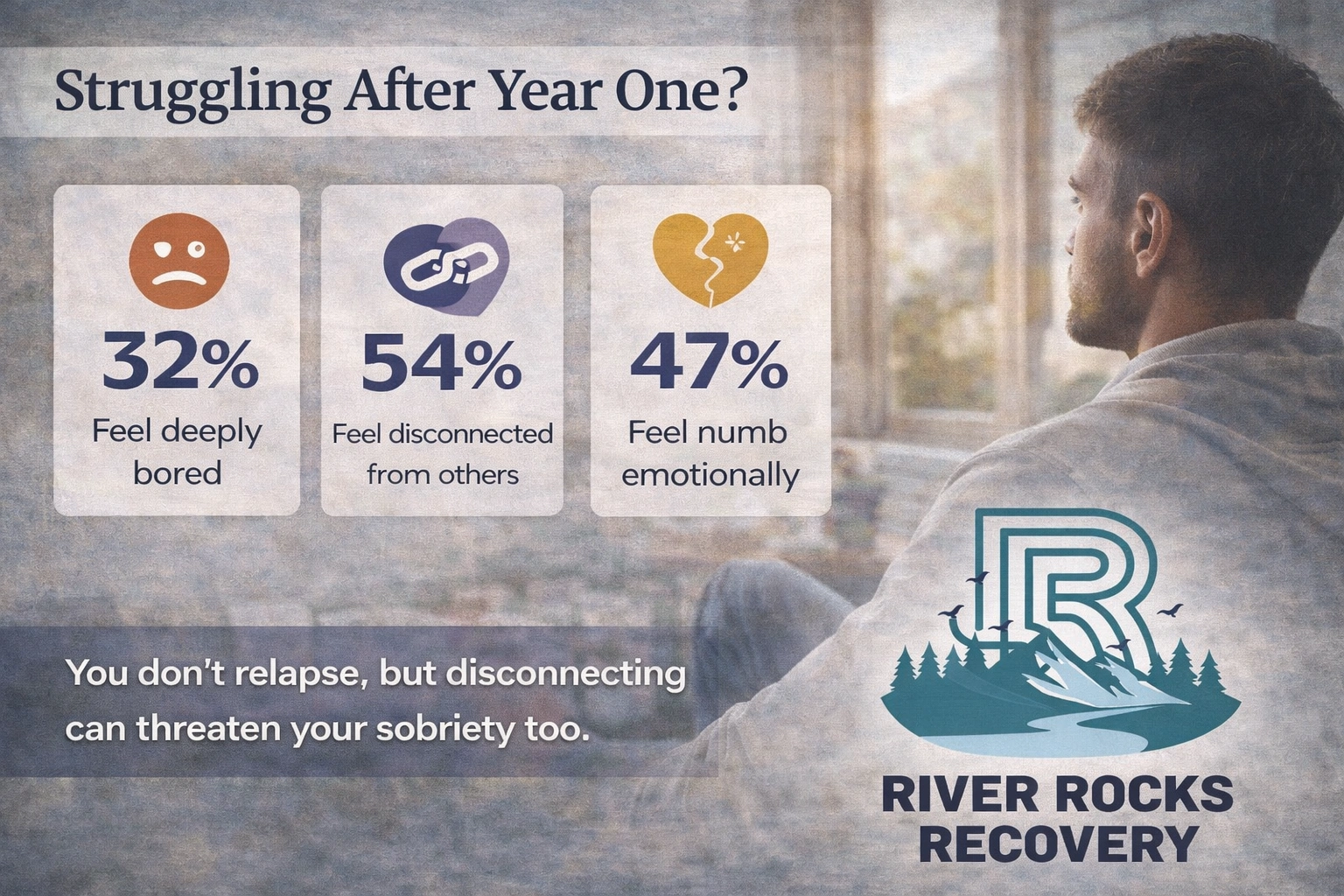
What happens when life calms down, but you start to feel off again? When you’ve made it through detox, through the cravings, through the constant worry of slipping—but you’re left with this quiet, nagging sense of… nothing?
I hit that wall at about 15 months sober. I wasn’t using. I wasn’t struggling in the obvious ways. But I also wasn’t really feeling anything anymore. I had a job. I showed up for my family. I went to the gym. I did the things.
But inside, it felt like something vital had shut off.
I didn’t know how to explain it to anyone. How could I complain when things were technically “fine”? I felt ungrateful. So I stayed quiet. And the more I isolated, the worse it got.
Eventually, I picked up the phone and called someone from River Rocks Recovery. I didn’t even know what I was asking for—I just knew I needed to feel connected again. And that call changed more than just my mood. It gave me back my sense of purpose.
If you’re sober and stuck, I want you to know you’re not doing it wrong. And you’re not alone.
When Sobriety Turns Into Emotional Numbness
Early recovery is loud. Every feeling is sharp, every win is huge, every challenge feels like climbing a mountain. You cry at commercials. You laugh like it’s the first time. It’s overwhelming, but it’s real.
But somewhere down the line, it goes quiet.
For me, the quiet became a kind of emotional fog. Not bad enough to scream for help. But not good enough to feel proud of. I wasn’t craving alcohol—I was craving something. Energy. Joy. Depth. Anything to feel like myself again.
At first, I thought maybe this was just adulthood. Or burnout. Or maybe I was just wired this way now.
But deep down, I knew what was missing: connection. Not just to people—but to myself. And that kind of reconnection doesn’t happen by accident. It takes intention—and support.
I Thought Needing Support Again Meant I’d Failed
That belief almost kept me quiet. I had done the work, right? I’d shown up. Stayed sober. Built a new life. Why was I struggling now?
I didn’t want to be the “alumni who backslid.” I didn’t want people to think I’d messed up.
But the truth is, healing doesn’t happen in one clean arc. You don’t graduate from needing support. You evolve with it.
Reaching out wasn’t failure—it was survival.
Why Reconnecting Made Me Feel Human Again
The shift didn’t come from going back to full-time treatment. It started with a conversation.
One person. One honest check-in. That was it.
They didn’t try to diagnose me or fix me. They just asked, “How are you really doing?”
And I told the truth.
From there, I found out about alumni events, peer support calls, and group spaces that were designed for people exactly in this space—long-term sober, but emotionally disconnected.
The more I leaned back in, the more I realized this wasn’t a step backward. It was the exact thing I needed to move forward.
There’s a Whole Life After Year One—But No One Prepares You for It
We spend so much time focusing on the early days of sobriety that we forget to prepare people for what comes later.
Things like:
- Navigating boredom that feels soul-deep
- Feeling like everyone’s moved on from your “story”
- Not knowing what your role in recovery is anymore
- The slow fade of community
- The pressure to be the example, even when you’re struggling
These aren’t signs you’re failing. They’re signs you’re human.
When I started showing up to alumni meetups again, it wasn’t just about seeing familiar faces. It was about being in a room where I didn’t have to pretend that “sober” always meant “happy.”
What I Saw in Hamilton, Ohio
I showed up to a peer-led group in Hamilton, Ohio, mostly to get out of my own head.
What I found was a circle of people who weren’t pretending to be perfect. Some were five years in. Others had relapsed and come back. Some just came to sit and listen.
There was one woman who said something I’ll never forget:
“I didn’t relapse, but I disconnected—and that almost took me out more than drinking ever did.”
That hit. Hard.
Because I knew exactly what she meant. And I realized I wasn’t alone in that gray space between “doing okay” and “something’s not right.”
The Power of Showing Up in Monroe, Ohio
Later that month, I went to an alumni event in Monroe, Ohio, even though I almost bailed. I kept thinking, “I don’t belong there anymore. That’s for new people.”
But someone at that event said, “You might be done with treatment, but treatment isn’t done with you.”
That landed different.
Because staying connected isn’t about staying in the past. It’s about protecting the future. It’s about remembering that the tools that saved you once don’t stop being useful just because life looks more stable.
You don’t need to be in crisis to need community. You just need to care enough to not go numb again.
FAQs for the Sober but Stuck
Is it normal to feel disconnected after a year or more of sobriety?
Yes. Many people experience emotional flatness or spiritual drift after the first year. It doesn’t mean something’s wrong—it just means you’ve hit a new phase that needs different support.
Do I have to go back to treatment to get help?
Not necessarily. Many long-term alumni benefit from support groups, alumni programs, or even occasional check-ins with counselors. You’re allowed to ask for what you need—without starting over.
What if I’m afraid people will think I relapsed?
You don’t owe anyone your story. But know this: anyone who’s really done the work will understand. Reaching out isn’t failure. It’s strength.
How can I reconnect without feeling awkward?
Start with honesty. “I’ve been feeling off lately and just wanted to reach back out.” That’s more than enough. The right people will make space for you.
Can I help others if I’m not feeling 100% myself?
Absolutely. In fact, showing up imperfectly might be the most helpful thing you do. Real stories from the middle of the mess often connect more than polished ones from the end.
Why This All Still Matters
You don’t stop being in recovery just because the emergencies stop.
And you don’t stop needing connection just because you’ve hit a certain milestone.
Sobriety isn’t about avoiding a drink. It’s about staying awake to your own life. And if you’re starting to feel numb, lost, or like the spark has faded, that doesn’t mean you’re failing.
It means you’re ready for a deeper kind of work—the kind that comes after the crisis. The kind that isn’t about survival anymore. It’s about staying alive in the truest sense.
You’ve made it this far. You don’t have to white-knuckle your way through what’s next.
Ready to Talk?
Call 888-905-6281to learn more about our alcohol addiction treatment in Middletown, Ohio.