
You may not say it out loud. Maybe you’ve never fully admitted it to anyone. But if you’re using opiates and you’ve thought about getting help, there’s one fear that shows up quietly but stubbornly:
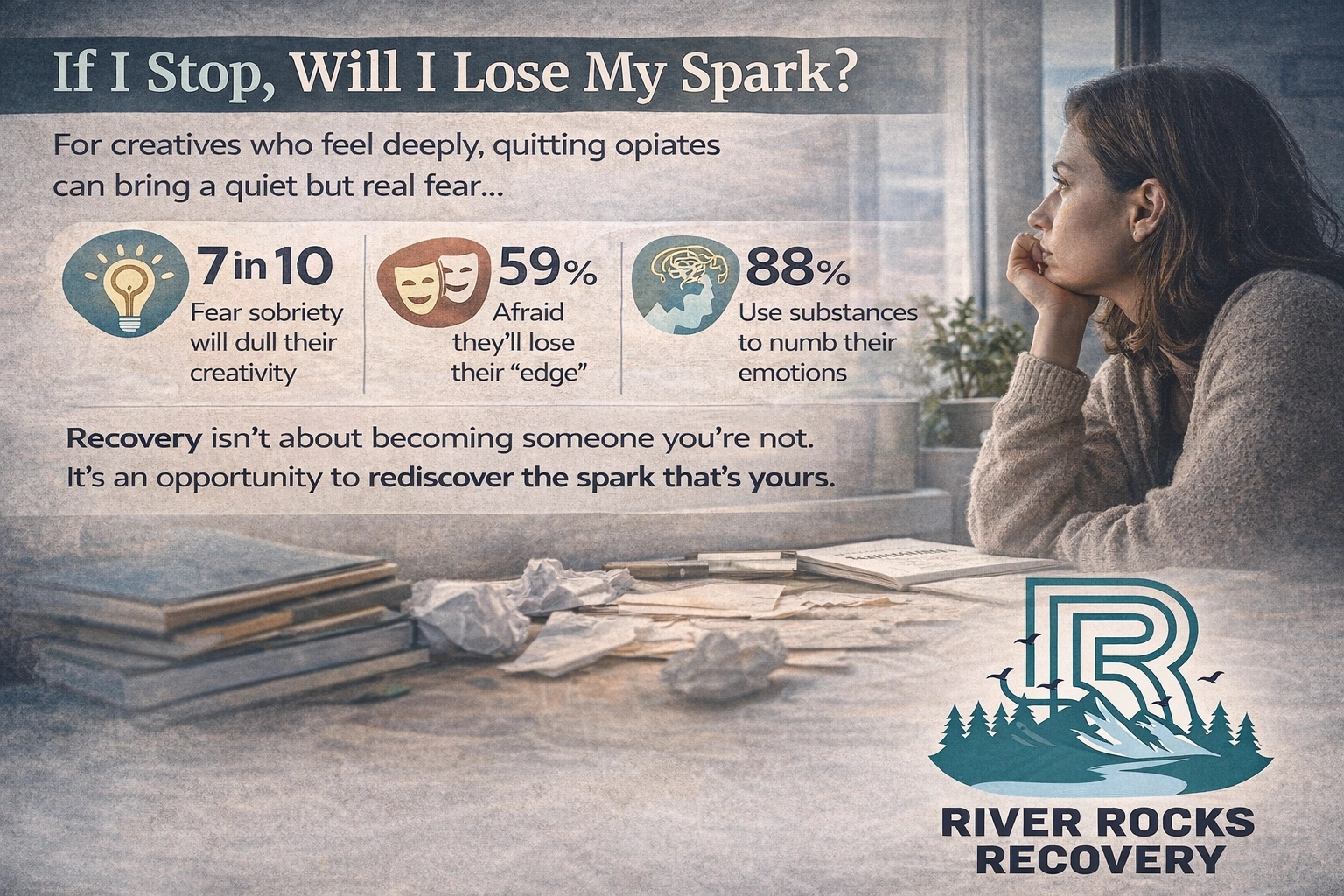
“If I stop, will I lose my spark?”
It’s not just about avoiding withdrawal. Or disappointing people. Or feeling shame. It’s something deeper—something tied to how you see yourself. Because for people who create, who feel everything deeply, who live a little left of center… sobriety can feel like a threat to your identity.
You’re not wrong for feeling this. And if this is why you haven’t reached out yet, you’re not the only one. At River Rocks Recovery, we’ve worked with musicians, writers, dancers, designers, coders, tattoo artists, and people who just feel different—and we’ve heard the same quiet question over and over:
“What if getting clean makes me boring? What if it takes the part of me that feels most alive?”
This blog won’t give you false comfort. But it might help you see that your edge—the part of you that feels electric—isn’t in your addiction. It’s in you.
Why You’re Afraid to Let Go
There’s a myth, especially in creative circles, that pain is the price of brilliance. That if you numb the chaos, you lose the art. That using isn’t self-destruction—it’s fuel.
And maybe, at first, it was fuel. Maybe it helped you tap into emotions you couldn’t otherwise reach. Maybe it made your walls come down just enough to say what you really meant in a song, a sketch, a script, or a late-night conversation. Maybe it helped you feel connected to something when everything else felt too loud or too distant.
But what started as fuel eventually becomes a fire that doesn’t stop burning.
And the truth is, if the thing that lights you up is also killing you slowly—taking your sleep, your clarity, your connections, your self-trust—then it’s not giving you your edge. It’s stealing it.
What Real Recovery Actually Looks Like
Let’s set aside the clichés. Forget the images of group hugs and inspirational posters on beige walls. Recovery, when it’s built right, isn’t about conforming. It’s about re-connecting—to your mind, your body, your creativity, and your truth.
In multi-day weekly treatment, recovery doesn’t mean erasing who you were. It means giving you the tools and space to rediscover what was already yours—before substances took over.
That might look like:
- Picking up your guitar without shaking
- Writing something raw and finishing it
- Feeling emotions fully and not being consumed by them
- Making decisions that feel like freedom, not survival
- Learning how to come down from a panic spiral without needing a substance to do it for you
You don’t lose your spark in recovery. You learn how to carry it without burning your hands.
A Real Fear: What If the Emptiness Is All That’s Left?
For a lot of people, especially those who create or perform, the thought of getting sober brings up something scary:
“What if the part of me that was interesting… was the part that used?”
It’s a fear rooted in the belief that sober equals flat. That without the highs and lows, you’ll be a blank page. Just a person doing normal things in normal ways, without depth or fire.
Here’s what people discover—again and again—when they finally take the step: the emptiness you’re afraid of isn’t from losing the drug. It’s what the drug was covering.
The numbness. The unprocessed pain. The lack of connection. That’s what shows up at first—not because you’re broken, but because you’re finally quiet enough to feel it. And when you start feeling it, you can start healing it. Then, the clarity comes. And the fire doesn’t go away—it focuses.
You Don’t Have to Flatten Yourself to Heal
So many creatives avoid treatment because they’re terrified of becoming someone else. Someone polished. Someone who can’t handle darkness. Someone who gives up the wildness that once felt like the only true thing.
But real recovery doesn’t ask you to trade your edge for peace. It asks if you want your edge to be something you control, rather than something that controls you.
It’s not about playing it safe. It’s about not playing Russian roulette with your own mind anymore.
In Hamilton, Ohio, we’ve seen this unfold in real time. People who walked into treatment thinking they had to let go of everything that made them feel alive—only to discover, a few weeks in, that they were more creative, more present, more them than they’d been in years.
And in Monroe, Ohio, we’ve worked with folks who thought their best work came from the chaos. But as they started healing, they found their ideas came faster, clearer, and with more staying power. Not in the haze of 3 a.m. spirals, but in real time, with real feeling—and no crash.
These are not exceptions. They’re examples of what happens when recovery is built for who you are—not who someone else thinks you should be.
What Treatment Can Offer That You Might Not Expect
Here’s what people afraid of losing themselves often find once they’re in recovery:
- Validation of your fear, not dismissal. Good clinicians won’t try to talk you out of your edge. They’ll help you keep it.
- A safe place to test your voice—without substances or pressure. You get to experiment with how you express yourself while sober, with support nearby.
- Real talk, not fluff. The best treatment spaces make room for weirdness, darkness, humor, resistance, and doubt. You don’t have to be anyone but who you are.
- New tools for old emotions. You still feel deeply. But now you don’t have to crash or disappear afterward. That’s power.
Frequently Asked Questions
What if I’m not ready to say I want to stay sober forever?
That’s okay. Recovery isn’t an all-or-nothing performance. You can show up with doubts, questions, and even resistance. Treatment is a space to explore—not commit blindly.
Do I have to give up my creativity or change my personality?
No. Treatment helps you reconnect to your creativity, not replace it. We’ve seen people create more freely after they stopped using. You won’t lose your voice—you’ll get it back.
Will I still feel things deeply without substances?
Yes. In fact, you’ll probably feel things more clearly. But you’ll also have the skills to hold those feelings, instead of being crushed by them.
I’ve never fit into traditional therapy settings. Will this be different?
Many of our clients have felt that way. That’s why our programs emphasize individual experience, flexible approaches, and room for real personalities—not just textbook cases.
What if I don’t want to be fixed—I just want to feel okay again?
You don’t need fixing. You need space, support, and the right tools to get back to who you are underneath all the noise. Recovery makes room for that.
Ready to Talk?
Call 888-905-6281 to learn more about our opiate addiction treatment in Middletown, Ohio.