
She didn’t cry when she told me.
Her voice was flat. Tired. But behind her words, I could feel something tangled—like someone gripping a version of herself that she didn’t want to lose.
“I’m not just scared to stop,” she said. “I’m scared that when I do… I won’t be me anymore.”
And that’s when I knew we weren’t just talking about substance use. We were talking about identity.
For many people—especially creatives, deep feelers, and emotionally expressive types—substances become more than a coping tool. They become a kind of performance enhancer for existence. A way to feel more. A way to express more. A way to be more… you.
Until one day, the thing that helped you survive starts hollowing you out.
As a clinician working in a Partial Hospitalization Program, I’ve walked alongside hundreds of people through this fear. And I want to say this gently but clearly:
You are not your survival strategies.
You are not your pain-turned-personality.
You are still here—underneath it all.
And in PHP, we help you find that version of yourself again. No pressure. No performance. Just presence.
You Used to Feel Everything—Now It Feels Like Too Much
Creative, emotionally tuned-in people often develop an early relationship with intensity. Emotions show up in big waves. Relationships are full of meaning. Small things feel significant. And in a world that doesn’t always know how to hold that intensity, you find ways to manage it.
Sometimes that means numbing. Sometimes it means amplifying. But over time, those survival habits stop helping—and start running the show.
I’ve had clients say:
- “I thought the high was what made me deep.”
- “I’m scared I’ll go flat without it.”
- “What if I’m just… ordinary?”
If that sounds familiar, I want you to know: intensity is not your problem. But your nervous system needs a new way to carry it.
PHP Isn’t About Erasing You
When people hear “treatment,” they imagine being reshaped or corrected. But our Partial Hospitalization Program at River Rocks Recovery isn’t about turning you into someone else. It’s about giving you the space—and the support—to peel back what’s not actually you.
That includes:
- The mask you wear to appear “fine”
- The self-hype that only shows up after a few drinks
- The emotional flooding that leaves you exhausted
- The belief that your creative spark only exists in chaos
In PHP, we slow everything down. You attend treatment during the day, go home at night, and in between, you begin to separate what helped you survive from what you want to carry forward.
Identity Isn’t Built on Escape
One client—let’s call him Jordan—told me he felt like substances gave him “permission” to be his full self. He’d write music, talk philosophy, cry in front of friends. It felt honest. But eventually, it also felt like he couldn’t get there unless he used. Without it, he felt blocked.
Through group work, creative expression, and trauma processing in PHP, Jordan started to notice something surprising:
He still cried when something moved him.
He still had deep thoughts.
He still made music that mattered.
The difference? He remembered it the next day. He didn’t second-guess it. He didn’t need a substance to access it.
The truth was, the creative, emotional, big-hearted person he feared losing was never the problem. The problem was the belief that pain was the only door to access it.
Why Emotional Depth Feels So Tied to Substance Use
There’s a reason this fear is so common. Substances often:
- Lower inhibition → leading to emotional sharing
- Heighten sensation → creating stronger memory
- Disrupt time perception → giving the illusion of flow or connection
- Block shame → making it easier to express things normally hidden
So, yes—it feels like you lose access to those parts of yourself without them. But in PHP, we teach you how to find new pathways to those parts. More sustainable ones. More reliable ones. Ones that don’t leave you gutted the next day.
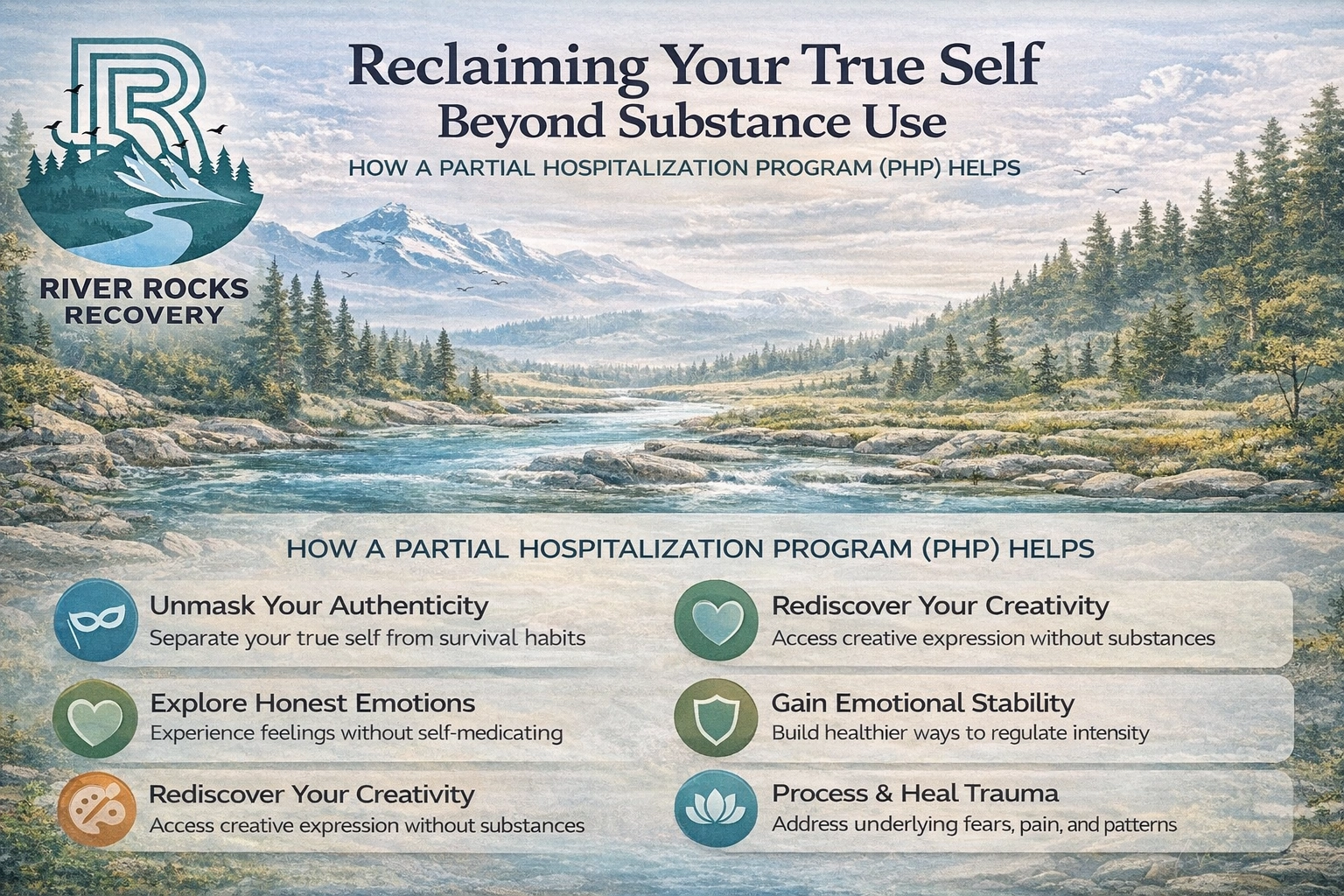
What Happens in a Partial Hospitalization Program?
A Partial Hospitalization Program (PHP) is one of the highest levels of outpatient care available. It’s designed for people who need more support than weekly therapy, but don’t require 24/7 residential care.
At River Rocks Recovery in Middletown, Ohio, our PHP includes:
- Group Therapy: Where you’re seen, heard, and held—without performance.
- Individual Therapy: A place to unpack the deeper “why” behind your fears and patterns.
- Creative Expression: Music, art, writing, movement—ways to access identity without substances.
- Skill Building: Emotional regulation, boundary-setting, communication tools.
- Psychiatric Support: For those needing medication evaluation or stabilization.
If you’re looking for a Partial Hospitalization Program in Monroe or West Chester, Ohio, we offer the same depth of care—close to home, grounded in real connection.
Creativity Without Chaos? It’s Possible
There’s a myth—especially among artists, musicians, and deep feelers—that creativity requires suffering. Or that sobriety means becoming bland, beige, forgettable.
Here’s what I’ve seen instead:
- Clients who write more clearly when their mind is still.
- Artists who reconnect with joy instead of only pain.
- People who finally feel safe enough to share work they used to hide.
PHP isn’t a creativity killer. It’s often the first space where someone feels like they don’t have to bleed for their art.
You Don’t Have to Be “Better” to Be Worthy
This might be the most important part.
In PHP, we don’t expect you to show up inspired, productive, or even hopeful. We just want you to show up. That’s it.
You are allowed to be tired.
You are allowed to be unsure.
You are allowed to want sobriety and miss the high at the same time.
This isn’t a performance. It’s a process.
FAQs About Partial Hospitalization and Identity in Recovery
Will I lose my personality if I stop using?
No. What you’ll lose are the patterns and behaviors tied to survival. Your humor, your heart, your curiosity, your creativity—those are you. PHP helps you find them again, without the static of substance use.
How is PHP different from regular therapy?
PHP is much more intensive than weekly therapy. Instead of one hour a week, you attend multiple hours a day, 5–6 days a week. It’s like a daily reset button that allows you to do deep work while still living at home.
What if I don’t feel “sick enough” for treatment?
You don’t have to hit rock bottom to deserve help. Many of our PHP clients are high-functioning, creative, and emotionally aware—but struggling. That’s enough.
Can I still be creative in treatment?
Absolutely. In fact, many people reconnect with their creativity in more honest, sustainable ways through PHP. We offer space for expression—and safety to explore it.
What happens after PHP?
Many clients step down into our Intensive Outpatient Program (IOP) or continue with weekly therapy. Others join alumni groups or peer-led recovery communities. You’re not left hanging.
How long does PHP usually last?
Most programs run 2–6 weeks, depending on your needs. At River Rocks Recovery, we personalize the timeline to fit your goals, your progress, and your capacity.
Final Thought: The Spark Is Still There
Sobriety doesn’t shrink your spirit. It gives it room to breathe.
Inside a Partial Hospitalization Program, we aren’t trying to change who you are. We’re helping you meet yourself again—without the noise, without the shame, without the substances acting as translator.
The truth is, you were always deep. You were always creative. You were always enough.
Sobriety just makes it sustainable.
You don’t have to disappear to feel something real.
Call (888) 905-6281 to learn more about our Partial Hospitalization Program services in Middletown, Ohio. Let’s find the you behind the survival. We’re ready when you are.