

When your child is in crisis, “enough” is the scariest word in the world. Is this enough support? Enough safety? Enough to stop the spiral?
We hear this from parents every day. The fear behind the question Is a partial hospitalization program enough? isn’t just about the program. It’s about your child’s life, their stability, and your role in protecting them when everything feels out of your control.
At River Rocks Recovery, we take that fear seriously. And we also believe in offering something steadier than guesswork—clinical clarity, grounded care, and constant reassessment.
Our partial hospitalization program (PHP) is often the right fit for families navigating behavioral health crises. But the only real answer to “Is it enough?” comes from continuous, compassionate assessment—based on your loved one’s safety, readiness, and real-time needs.
What Is a Partial Hospitalization Program (PHP)?
A partial hospitalization program is a highly structured treatment option designed for individuals who need more than traditional outpatient therapy—but who may not require 24/7 inpatient care. PHP typically includes:
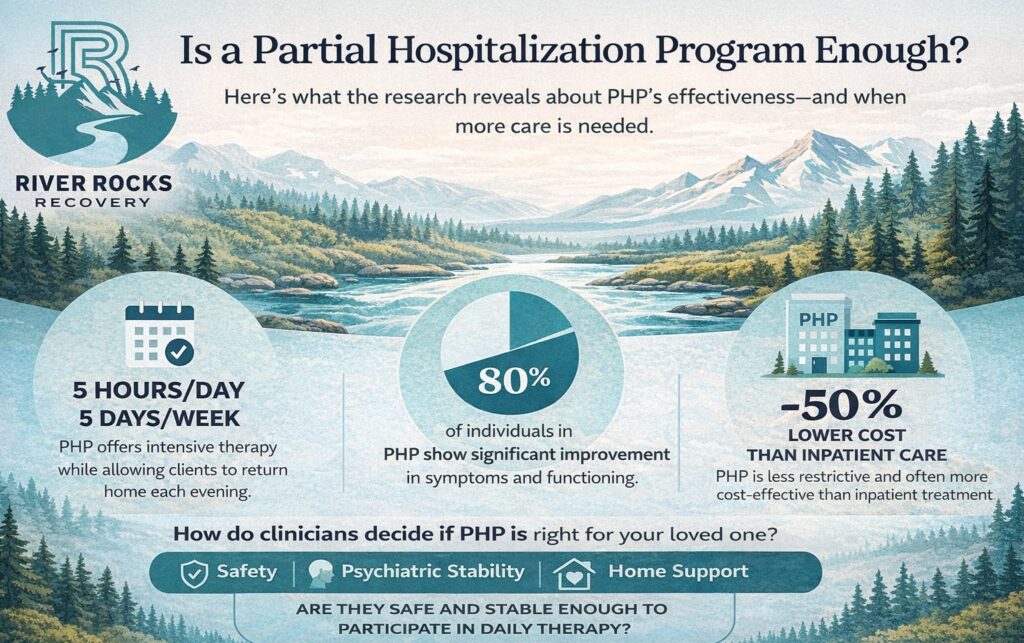
- 5 to 6 hours of therapeutic programming daily, Monday through Friday
- Individual therapy focused on symptom management and emotional processing
- Group therapy to build coping skills and connection
- Family support and care coordination
- Medication management by licensed psychiatric providers
People return home in the evenings or stay in supportive housing depending on their needs.
Think of PHP as the treatment world’s version of a safety net: not a hospital bed, but not freedom without support. It’s a structured middle path that can offer stability without over-restricting.
Who Is PHP Designed For?
Clinically, PHP is most appropriate for individuals who:
- Are struggling with severe mental health symptoms (e.g., depression, anxiety, mood instability)
- Have been recently discharged from inpatient care but still need daily support
- Need a high level of care but do not pose an immediate risk to themselves or others
- Have a stable enough living situation to support healing after daily treatment
- Are medically stable and not in need of detoxification or round-the-clock supervision
For parents, this can be a hard call. You might see the behavior, the fear, the outbursts—and feel unsure how anyone could say they’re “not bad enough” for inpatient.
But here’s what most families don’t know: Severity doesn’t always require sedation or hospitalization. Sometimes, the best thing for your child is to begin stabilizing while still connected to the outside world—especially if they’re young, overwhelmed, or scared by the idea of being “locked away.”
How Clinicians Assess Whether PHP Is Enough
This is where professional judgment matters most. Before admission, our team conducts a full clinical assessment to answer one central question: Is PHP the safest, most appropriate level of care right now?
We evaluate:
1. Risk of Harm
- Are there active suicidal or homicidal thoughts?
- Is there a recent attempt or plan in place?
If yes, inpatient care may be necessary first. PHP is not a holding space for those in acute danger.
2. Psychiatric Stability
- Are symptoms of psychosis, mania, or disassociation disrupting daily function?
- Is there awareness of one’s condition?
If someone is fully detached from reality or unable to participate in treatment, PHP might be too soon.
3. Environmental Support
- Can the home or living space provide safety?
- Are there caregivers or routines that reinforce treatment?
Even the best PHP can’t compensate for a chaotic, dangerous, or triggering home environment.
4. Motivation and Insight
- Is the individual willing to engage in treatment?
- Do they have at least some awareness of their condition?
While we don’t expect perfect insight, some level of participation is necessary for PHP to work.
Stabilization Is a Process, Not a Box to Check
Many parents come in hoping PHP will “get them stable.” And it can—but stabilization isn’t a one-time achievement.
Stabilization is a series of small victories, each one helping your child move from overwhelmed to engaged, from unsafe to supported. Clinicians look for:
- Symptom reduction: Less emotional volatility, fewer intrusive thoughts
- Functional gains: Better sleep, nutrition, grooming, daily habits
- Relational improvements: Less isolation, more communication, trust-building
- Clinical engagement: Attending groups, participating in therapy, taking medication
If those pieces begin to click, PHP might be the beginning of sustainable healing—not just a stopgap.
What Happens If PHP Isn’t Enough?
This is every parent’s quiet panic: What if it’s not working?
We want you to know: You won’t have to figure that out alone. PHP is not a locked-in level of care. At River Rocks Recovery, we reassess continuously—daily if needed.
If symptoms escalate, we don’t wait. We’ll recommend the next step up, coordinate care with inpatient facilities, or discuss residential treatment options.
And if your child stabilizes more quickly than expected? We step them down—to intensive outpatient (IOP) or traditional outpatient therapy—with support the whole way.
You’re never stuck in a plan that doesn’t fit your child’s reality.
If Substance Use Is Involved, Treatment May Need to Be Dual-Focused
Behavioral health doesn’t always travel alone. If your child’s mental health crisis also involves meth use or other substances, we recommend exploring dual-diagnosis options or integrated care models. River Rocks offers specialized methamphetamine rehab services in Ohio that can complement PHP for clients dealing with both addiction and psychiatric instability.
What Parents Need to Hear (But Rarely Do)
Let’s be honest: no one prepares you for this. For the way it feels to watch your child unravel. For how impossible it is to know whether you’re making the right decision. For the guilt that gnaws even when you’ve done everything “right.”
You didn’t fail. Your child didn’t fail. Crisis isn’t failure—it’s a signal. One that says it’s time to stop pretending everything’s fine and start building something better.
And that? That takes support.
FAQ: Partial Hospitalization Program Questions, Answered
Is PHP inpatient or outpatient?
PHP is considered outpatient care, even though it’s highly intensive. Patients attend treatment during the day and return home or to supportive housing at night.
How long does PHP last?
The average length of stay in PHP is 2 to 6 weeks, but this varies depending on clinical progress. We adjust the treatment plan as your loved one stabilizes.
Does PHP include medication management?
Yes. Clients meet regularly with psychiatric providers for medication assessment, prescription management, and symptom monitoring.
Can my child work or go to school during PHP?
Generally, PHP is a full-time commitment during the day. Some individuals return to work or school part-time after stabilizing and stepping down to IOP.
What if we start PHP and it’s not enough?
That’s okay. Our team will continuously assess and recommend next steps if more care is needed. You’ll never be left to figure it out alone.
When You’re Ready to Talk, We’re Here
You don’t have to make this decision alone. Call (888) 905-6281 or visit to learn more about our partial hospitalization program services in Middletown, Ohio.