


Cash flow problems in an IOP program rarely come from a single breakdown. They build quietly—underfilled groups, missed sessions, delayed documentation, and avoidable denials stacking up over time.
For practice owners, this creates a frustrating cycle: revenue feels unpredictable, growth stalls, and operational pressure increases.
The reality is, most IOP cash flow issues aren’t about demand—they’re about structure. If you’re evaluating how your intensive outpatient program structure is performing financially, optimizing scheduling and utilization is one of the fastest ways to stabilize revenue without increasing overhead.
Start with a True Utilization Analysis (Not an Estimate)
Most owners believe they know their utilization rate—but few are tracking it accurately.
True utilization isn’t how “busy” your schedule looks. It’s the percentage of billable capacity actually filled and attended.
For example:
- 30 available group slots per week
- 21 filled consistently
- 70% utilization
That 30% gap is not just empty space—it’s lost revenue.
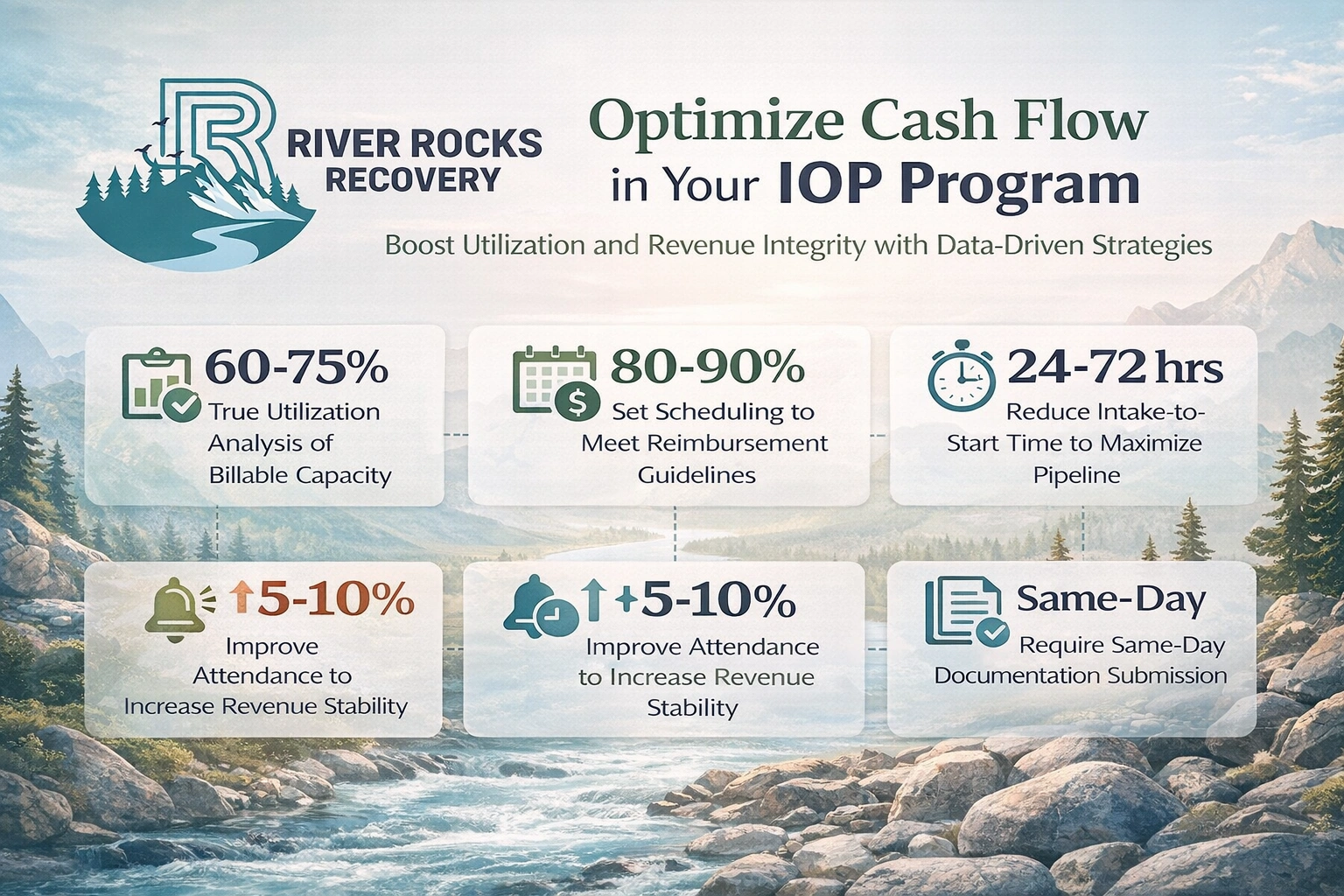
Across behavioral health, many IOP programs operate between 60–75% utilization, which means 25–40% of potential revenue is unrealized.
Even improving utilization by 10% can result in a meaningful monthly increase without hiring additional staff.
Design Your Schedule Around Reimbursement, Not Convenience
One of the most common operational mistakes is building schedules based on clinician preference rather than payer requirements.
IOP reimbursement is tied directly to:
- Weekly service hour thresholds
- Frequency of sessions
- Consistency of attendance
If your schedule allows patients to fall below required participation levels, you are delivering care that may not be reimbursed.
Example scenario:
- Payer requires 9+ hours/week
- Patient attends only 6–7 hours due to scheduling gaps
- Claim risk increases significantly
To correct this:
- Standardize weekly schedules that meet payer thresholds
- Limit “optional” attendance structures
- Build accountability into scheduling
Revenue integrity begins with clinical scheduling alignment.
Eliminate Intake-to-Start Delays Immediately
One of the fastest ways to improve cash flow is reducing the gap between assessment and first billable service.
Every day a patient waits:
- Revenue is delayed
- Drop-off risk increases
- Engagement declines
High-performing programs target 24–72 hours from intake to first session.
To achieve this:
- Maintain rolling group admissions
- Hold reserved slots for new patients
- Coordinate intake and clinical teams in real time
A faster intake-to-start pipeline directly accelerates your revenue cycle.
Standardize Weekly Scheduling Templates Across Your Program
Inconsistent scheduling leads to inconsistent revenue.
When group times, durations, and clinician assignments constantly change:
- Attendance drops
- Documentation errors increase
- Billing becomes inconsistent
Instead, implement fixed scheduling templates:
- Same group times weekly
- Defined session lengths
- Consistent clinician coverage
This creates:
- Predictable billing patterns
- Improved patient adherence
- Reduced administrative friction
Consistency is not just operational—it’s financial.
Treat Attendance as a Core Revenue Driver
Attendance is often viewed as a clinical metric—but financially, it’s one of your most important KPIs.
Missed sessions directly impact:
- Billable hours
- Weekly authorization compliance
- Overall revenue stability
Top programs actively monitor:
- No-show rates by time slot
- Drop-off trends by week of treatment
- Engagement dips tied to scheduling patterns
A 5–10% improvement in attendance can significantly increase revenue without any additional marketing spend.
Operational strategies include:
- Automated reminders (text/email)
- Same-day follow-up for absences
- Flexible scheduling blocks for high-risk patients
Balance Clinician Productivity Without Creating Burnout Risk
Cash flow optimization is not about maximizing output at any cost.
Overloading clinicians leads to:
- Documentation delays
- Increased errors
- Higher denial rates
Underutilization leads to:
- Lost revenue
- Inefficient staffing costs
Industry benchmarks suggest:
- 70–80% of clinician time should be billable
- Remaining time reserved for documentation and coordination
Smart scheduling balances both.
This ensures:
- Sustainable staff performance
- Consistent documentation quality
- Stronger reimbursement outcomes
Fix Documentation Bottlenecks That Delay Payments
You can have perfect scheduling—and still struggle with cash flow if documentation is inconsistent.
Common breakdowns include:
- Late note completion
- Missing clinical justification
- Non-compliant documentation formats
Each of these creates delays in claims submission and increases denial risk.
To correct this:
- Require same-day documentation completion
- Use standardized, payer-aligned templates
- Conduct weekly internal audits
Clean documentation shortens your revenue cycle and reduces rework.
Stop Assuming Growth Requires More Patients
This is one of the most expensive misconceptions in behavioral health operations.
When cash flow tightens, many owners default to:
“Let’s increase marketing and bring in more patients.”
But if your program is underutilized, more patients won’t fix the problem—they’ll increase operational strain.
Before investing in growth, evaluate:
- Are your current groups at capacity?
- Are patients attending consistently?
- Are all billable services being captured?
In many cases, optimizing utilization delivers faster ROI than increasing admissions.
Build Predictability Into Your Revenue Cycle
The ultimate goal isn’t just higher revenue—it’s predictable revenue.
When scheduling, utilization, and documentation align:
- Claims are submitted faster
- Denials decrease
- Cash flow stabilizes
This allows practice owners to:
- Forecast revenue with confidence
- Plan hiring strategically
- Scale without operational chaos
For providers operating near Hamilton, Ohio, improving internal program efficiency can often unlock growth opportunities without expanding physical footprint or staffing immediately.
Use Data to Continuously Refine Performance
High-performing IOP programs don’t set schedules and forget them.
They track, measure, and adjust consistently.
Key metrics to monitor:
- Utilization rate (%)
- Average attendance per patient
- Intake-to-start timeline
- Clinician billable hours
- Denial rates and reasons
Monthly review of these metrics allows you to:
- Identify bottlenecks early
- Adjust scheduling proactively
- Protect revenue before issues escalate
For practices expanding services into areas like Monroe, Ohio, data-driven decision-making becomes even more critical to maintain consistent financial performance across locations.
FAQs: IOP Program Cash Flow Optimization
What is the fastest way to improve IOP cash flow?
Improving utilization and reducing intake delays are typically the fastest levers. Even small gains in these areas can produce immediate financial impact.
How much does attendance really affect revenue?
Significantly. Every missed session is lost billable revenue and can impact authorization compliance, increasing denial risk.
Should I hire more staff to increase revenue?
Not necessarily. If your current program is underutilized, optimizing scheduling and attendance will deliver better ROI than increasing staffing costs.
How do I reduce claim denials in an IOP program?
Align scheduling with payer requirements, ensure consistent attendance, and maintain high-quality, timely documentation.
What utilization rate should I aim for?
Most programs should target 80–90% utilization for optimal financial performance without overloading staff.
Is scheduling really that important for revenue?
Yes. Scheduling directly impacts attendance, compliance, and billable hours—all of which determine reimbursement.
Strengthen Your Program Without Increasing Overhead
Cash flow challenges are rarely about demand—they’re about design.
When your IOP program is structured correctly:
- Every scheduled hour has revenue potential
- Every patient pathway supports reimbursement
- Every operational process reinforces financial stability
That’s how programs move from reactive to scalable.
Ready to Improve Your IOP Program’s Financial Performance?
If your program is experiencing inconsistent revenue, the solution may be more strategic than you think.
Call (888) 905-6281 or visit our Intensive Outpatient Program in Middletown, Ohio to learn how smarter scheduling, stronger utilization, and better operational design can improve your cash flow and long-term growth.