


You Left. It Happens. And Yes—You’re Allowed to Come Back.
Maybe it started with a missed group. Or two. Maybe you ignored a voicemail from the case manager. Maybe you told yourself you’d be back next week, then next week turned into three months.
However it unfolded, you’re here now—thinking about returning to your Intensive Outpatient Program and wondering if that’s even allowed.
It is.
At River Rocks Recovery, we know that treatment doesn’t always go in a straight line. People ghost. People pause. People disappear without explanation. That doesn’t make you broken. It makes you human. And it definitely doesn’t mean you can’t return.
If you’ve been carrying guilt about leaving or fear about coming back, this blog is for you. Let’s walk through how to start again—with grace, with support, and with zero judgment.
1. Start With This Truth: You’re Not the Only One
Dropping out of IOP doesn’t make you the exception—it makes you part of a very normal pattern in recovery.
Maybe it was stress. Maybe it was shame. Maybe something else in life hit harder than you expected. Or maybe you can’t even name what happened—you just…stopped.
We’ve seen it all before:
- The person who felt overwhelmed and vanished after week two
- The person who made it to graduation, relapsed, and felt too ashamed to call
- The person who stopped coming and then thought, “It’s too late to go back now”
They all came back. And when they did, we didn’t ask, “Why did you leave?”
We said, “We’re glad you’re here.”
2. Talk to Yourself Like You’d Talk to a Friend
The biggest barrier to re-entry isn’t usually logistics—it’s shame.
You might be telling yourself:
- “They probably don’t want me back.”
- “I already blew my shot.”
- “They’ll think I’m flaky or not serious.”
But ask yourself: if a close friend told you, “I left my treatment program and I’m thinking about returning, but I’m scared,”—what would you say?
Probably something like:
“You’re allowed to come back. You’re not a failure. You’re trying again—and that’s brave.”
Now say it to yourself. Out loud if you need to.
3. Make the Call Before You Talk Yourself Out of It
The hardest part is often the first step: reaching out.
You don’t need a perfect script. You don’t need to explain every detail of what happened. A simple, “Hi, I was in IOP here before and I want to talk about starting again,” is more than enough.
When you contact River Rocks Recovery, you’ll be met with understanding. We’re not here to quiz or judge you. We’ll ask how you’re doing and talk through your options. That’s it.
If you’re located in Monroe, West Chester, or Dayton, Ohio, we’ve got programs near you that can meet you exactly where you are—emotionally and logistically.
4. Expect a Clean Slate—Not a Lecture
We’re not going to make you “earn” your way back. You’ve already earned it by wanting to try again.
Here’s what rejoining might look like:
- You’ll meet with a staff member to talk about what worked, what didn’t, and what you’d like to do differently this time.
- You might return to the same group, or join a new one if that feels more supportive.
- You’ll have a chance to co-create a schedule that works better for your current life.
Whether it’s been three weeks or three years, your past participation is just that—past. We’re focused on the version of you that showed up today.
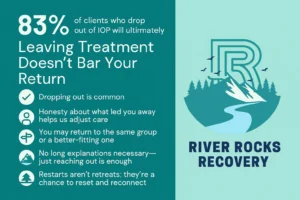
5. Be Honest About What Made You Leave
You don’t have to share everything. But if you can name what pulled you away—stress, burnout, resistance, relapse, fear—it can help us support you more clearly this time.
Sometimes it wasn’t even that deep. Maybe your schedule got chaotic. Maybe you missed a few sessions and felt awkward about coming back. That’s valid too.
There’s no “right reason” to step away. And there’s no wrong way to come back.
6. Understand That Ghosting Happens in Recovery—A Lot
Disappearing isn’t just about avoidance. It’s often about emotional overload.
IOP can stir things up—grief, memories, fear, even hope. For some people, that’s scary. For others, it’s just too much to manage on top of everyday life.
Here’s what we know:
- Ghosting doesn’t mean you weren’t committed.
- Ghosting doesn’t cancel the progress you made.
- Ghosting doesn’t mean you’re not allowed back in.
It just means you hit a wall—and now you’re circling back, wiser.
7. Adjust the Structure to Support This Version of You
Maybe your job is different now. Your family situation. Your mental bandwidth. Your needs aren’t the same—and your treatment plan shouldn’t be either.
When you re-engage in our Intensive Outpatient Program, we can:
- Adjust your session schedule (morning or evening options)
- Pair you with a new therapist if needed
- Talk through emotional safety in group settings
- Ease you back in with a pace that feels doable, not overwhelming
This isn’t a one-size-fits-all program. It’s yours.
8. Let This Be a Beginning—Not a Re-Do
You’re not picking up where you left off. You’re not repeating. You’re starting fresh—with experience behind you.
You already know what walking through the door feels like. You already know which parts of group feel helpful—or hard. That’s power.
This isn’t about proving anything. It’s about reconnecting with a part of you that still wants healing—even if the path took a detour.
9. Real Clients. Real Returns.
“I missed three sessions, then ghosted the program for a month. I was so embarrassed to call. But when I did, they just said, ‘We’re glad you reached out.’ No lectures. Just support.”
— Former IOP Client, 2023
“I thought I’d burned my bridge. Turns out the bridge was still there—I just had to take a step.”
— Re-engaged Client, 2024
You don’t have to pretend it didn’t happen. You just have to be ready for what comes next.
FAQs: Restarting IOP After Leaving
Will I be judged for leaving last time?
No. Our staff understands that people leave programs for many reasons—life stress, emotional overwhelm, or simply needing a break. You’ll be met with respect and support.
Do I have to explain why I ghosted?
Not unless you want to. We’ll never demand a reason or make you rehash your experience. You’re welcome to share whatever helps you feel ready to start fresh.
Can I return to my original group?
Possibly, depending on availability and timing. If you’d prefer a new group, we can arrange that too. What matters is finding a space that feels safe and helpful for you now.
Will I have to start from the beginning?
Not necessarily. We’ll talk with you to determine where you’re at emotionally and mentally. Some people resume close to where they left off. Others choose a full reset. We’ll support either path.
What if I’m afraid I’ll leave again?
That fear is normal. We can build in more structure, flexibility, or support this time to help it feel manageable. The goal isn’t perfection—it’s progress you can sustain.
The Door Was Never Closed
Call (888) 905-6281 to learn more about our Intensive Outpatient Program services in Middletown, Ohio. If you’ve been thinking about returning, that’s not weakness—it’s courage. Let’s start again. Together.