

You didn’t plan on disappearing.
Maybe you told yourself it was just a break. One skipped group. Then another. Maybe something happened—life, work, a relapse, or just… the weight of it all. And now it’s been weeks. Or months. And the thought of walking back into that room feels impossible.
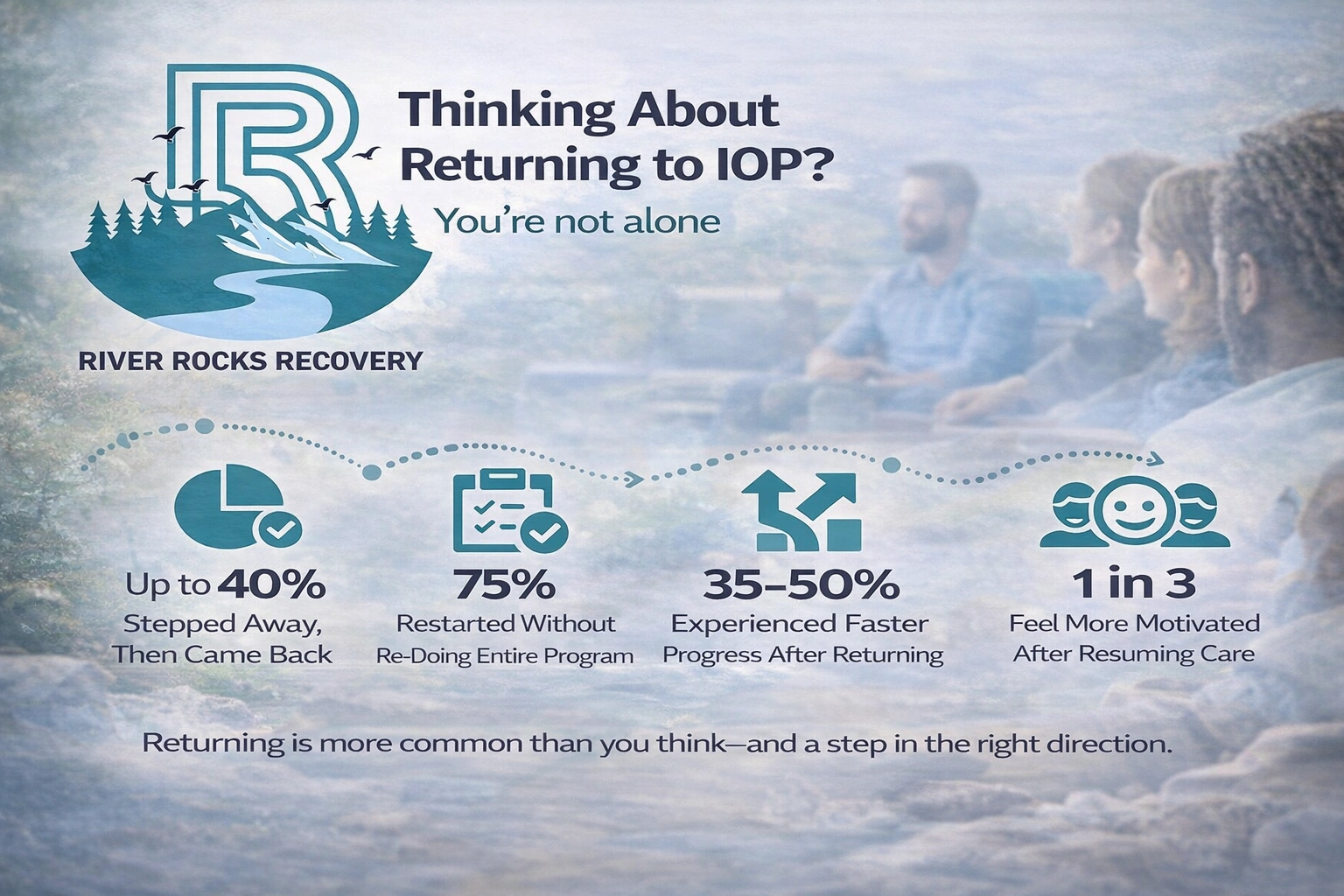
If that’s where you are, you’re not alone. People step away from an intensive outpatient program (IOP) all the time—and they return, too. Quietly, awkwardly, and often with more readiness than before.
At River Rocks Recovery, we work with people every day who left early, ghosted, or shut down mid-treatment. And here’s the truth: coming back doesn’t mean you failed. It means you still want something better. That’s all it takes to start again.
Step 1: Know That Avoidance Is Normal—and Reversible
Avoiding treatment doesn’t mean you’re broken. It means something in the process—emotionally or logistically—hit a threshold you couldn’t tolerate at the time.
Maybe it was the vulnerability. Maybe the group setting. Maybe you felt like the only one still struggling while everyone else “got it.” Maybe it was simply burnout.
Whatever the cause, it doesn’t disqualify you. You can pause and return. That’s part of how real recovery works: not in straight lines, but in human ones.
Step 2: Reach Out Without the Performance
You don’t have to sound polished to return. You don’t need a dramatic backstory or a heroic comeback.
You can call and say:
“Hey, I was in IOP and I’ve been out for a while… Can I come back?”
That’s more than enough. You don’t need to sell us on your motivation or prove your commitment. If you’re calling, that is your commitment.
We’re not keeping score. We’re keeping the door open.
Step 3: Come Back at the Speed You Need
One of the biggest myths about restarting IOP is that you have to jump back in at full speed. You don’t.
We’ll start by reassessing what’s actually happening for you now—not what was true weeks or months ago. That might mean adjusting your schedule, changing your therapist, or easing into smaller group sessions before diving back into the full structure.
For some returning clients, we recommend combining IOP with individual therapy for extra support. For others, we consider whether a more specialized path—like those needing support in methamphetamine rehab—might be more stabilizing before reentering group dynamics.
You don’t have to know the right path. You just have to show up and let us walk with you.
Step 4: Let Honesty Replace the Shame Script
If you’re telling yourself:
- “They won’t want me back.”
- “I already blew my chance.”
- “It’s embarrassing to return after quitting.”
Then let’s rewrite that.
It takes more courage to come back than to walk away. Anyone can ghost. Few people double back and say, “Actually, I still need help.” That’s powerful. That’s something to be proud of—even if your voice shakes when you say it.
And you won’t be the only one. We’ve had people return after a week, a year, or three separate attempts. What matters is this moment—not the one you left in.
Some of the most committed clients we’ve ever worked with were people who left, came back, and finally let it get real the second or third time. Returning wasn’t defeat—it was finally showing up with both feet on the ground. For many people, understanding how IOP still works after dropping out can make it easier to re-engage with treatment without feeling like they’ve failed or started over completely.
Step 5: Give Yourself Permission to Feel Awkward
It might feel weird at first. That’s okay. We’re not going to pretend it doesn’t.
You might worry about running into someone from your old group. You might feel behind. You might be nervous to talk about what’s been going on. That’s all part of the process. We hold space for it.
And here’s the good news: awkwardness passes. Especially when you realize no one’s judging you. In fact, most people respect the hell out of someone who comes back.
If you’re close to our intensive outpatient program in Monroe, Ohio, your return might be more logistically doable than you think. A short drive could be the only thing between you and a second chance that actually fits who you are now.
Step 6: Use What You Already Learned
Even if you don’t remember everything you heard in group… even if you relapsed… even if you swore you were “done” with treatment…
You still walked away with something. Some piece of language. Some moment of connection. Some skill you used for a week. It didn’t vanish.
When you return, we build from that—not from scratch.
We’ve seen people walk back into IOP and say, “I didn’t realize how much of this actually stuck with me.” For many individuals, understanding how an IOP adapts helps them see that treatment can be flexible and responsive to their changing needs over time. That’s the beauty of being human—learning often lingers under the surface until you need it again.
Step 7: Let Your Return Be Quiet—But Solid
You don’t need to make a big statement. You don’t need to shout “I’m back!” or prove your growth on day one.
Just walk in. Sit down. Let it be quiet, if that’s what you need.
For many individuals, understanding how an intensive outpatient program gave life back helps them recognize how consistent structure and support can gradually restore stability and confidence in recovery.
Progress doesn’t have to be loud. Sometimes it’s just a decision you make in your car before stepping inside. A decision that says, “I want more than this. And I’m willing to try again.”
That’s not weakness. That’s wisdom.
And if you live closer to our intensive outpatient program in Dayton, Ohio, that quiet return might be easier than expected. You don’t have to cross a state to reclaim your seat—you just have to take one step back toward care.
FAQs: Coming Back to IOP After Avoiding It
Will I have to start from week one?
Not necessarily. We’ll do a new assessment and adjust your care plan based on what’s changed. Sometimes you resume where you left off, other times we modify your approach.
Is relapse a dealbreaker for returning?
No. Relapse is common—and it’s a reason to come back, not a reason to stay away. We work with many clients who return after increased substance use, especially after stepping away from treatment too early.
What if I ghosted completely and never responded?
You’re still welcome. You don’t have to justify your absence to us. Just let us know you’re ready now.
Will other clients judge me for leaving and returning?
Unlikely. Most people are focused on their own healing. And those who notice? Often find your return inspiring.
Can I ask for a different group or therapist this time?
Yes. If something wasn’t a good fit last time, let us know. You deserve care that works for you, not just care that checks a box.
Is it too late if it’s been months or longer?
Never. Whether it’s been two weeks or two years, we’d rather you come back now than not at all.
Coming back doesn’t have to be perfect. It just has to be real.
Call (888) 905‑6281 to learn more about our intensive outpatient program in in Middletown, Ohio.