
You didn’t plan for this.
You weren’t prepared to recognize your own child in a panic-stricken voice message. Or to find an empty bottle under their bed. Or to wonder whether you were calling a treatment center or a last lifeline. And now, you’re here—searching for something that sounds less terrifying than “rehab,” but more helpful than waiting this out.
If your young adult child is in crisis—emotionally unstable, using substances, acting in ways that scare you—what you’re facing is more than a “phase.” It’s a behavioral health emergency.
And it deserves real, timely care.
Drug rehab treatment isn’t just for people with years of addiction behind them. It’s for families in crisis, too. For parents trying to figure out what’s mental health, what’s substance use, and what the next safe step looks like.
Here’s how integrated rehab treatment works—and why it could be exactly what your child needs, even if it’s the last thing you imagined.
When Crisis Doesn’t Fit in One Box
Most parents tell us they don’t know what’s really happening. They say things like:
- “They’re not themselves.”
- “One minute they’re angry, the next they’re crying.”
- “They keep disappearing for hours.”
- “I don’t know if it’s drugs or something else.”
Here’s the truth: you don’t need to know exactly what’s going on before reaching out. In fact, that’s why programs like ours exist—to assess, stabilize, and treat both substance use and mental health at the same time.
Why Mental Health and Substance Use Must Be Treated Together
In a crisis, trying to separate substance use from mental health symptoms is like trying to figure out whether the smoke or the fire came first. One fuels the other, and both need to be addressed for the situation to calm.
For example:
- Depression may lead your child to numb out with substances
- Substances may trigger or worsen psychosis, paranoia, or anxiety
- ADHD or trauma may drive impulsive behavior and risky use
- Undiagnosed mental health conditions often go unrecognized because drug use “explains everything”
If treatment focuses on just one piece of the puzzle, relapse—or even worsening symptoms—is likely. That’s why dual-diagnosis drug rehab treatment is the gold standard in crisis care: it supports both brain and behavior, both diagnosis and dignity.
What Happens When a Young Adult Enters Drug Rehab in a Crisis?
At River Rocks Recovery, the first thing we do isn’t treatment—it’s understanding.
That starts with a full clinical assessment. We take time to learn:
- What’s happening right now (including safety concerns)
- How long symptoms or use have been present
- What mental health symptoms have been diagnosed—or overlooked
- What substances have been used, how often, and in what context
- What stressors, traumas, or losses may be contributing to the crisis
We also talk with the family—carefully, respectfully—to understand dynamics and history. Because context matters. And no one knows your child better than you.
Only after we’ve gathered this information do we recommend the most appropriate level of care.
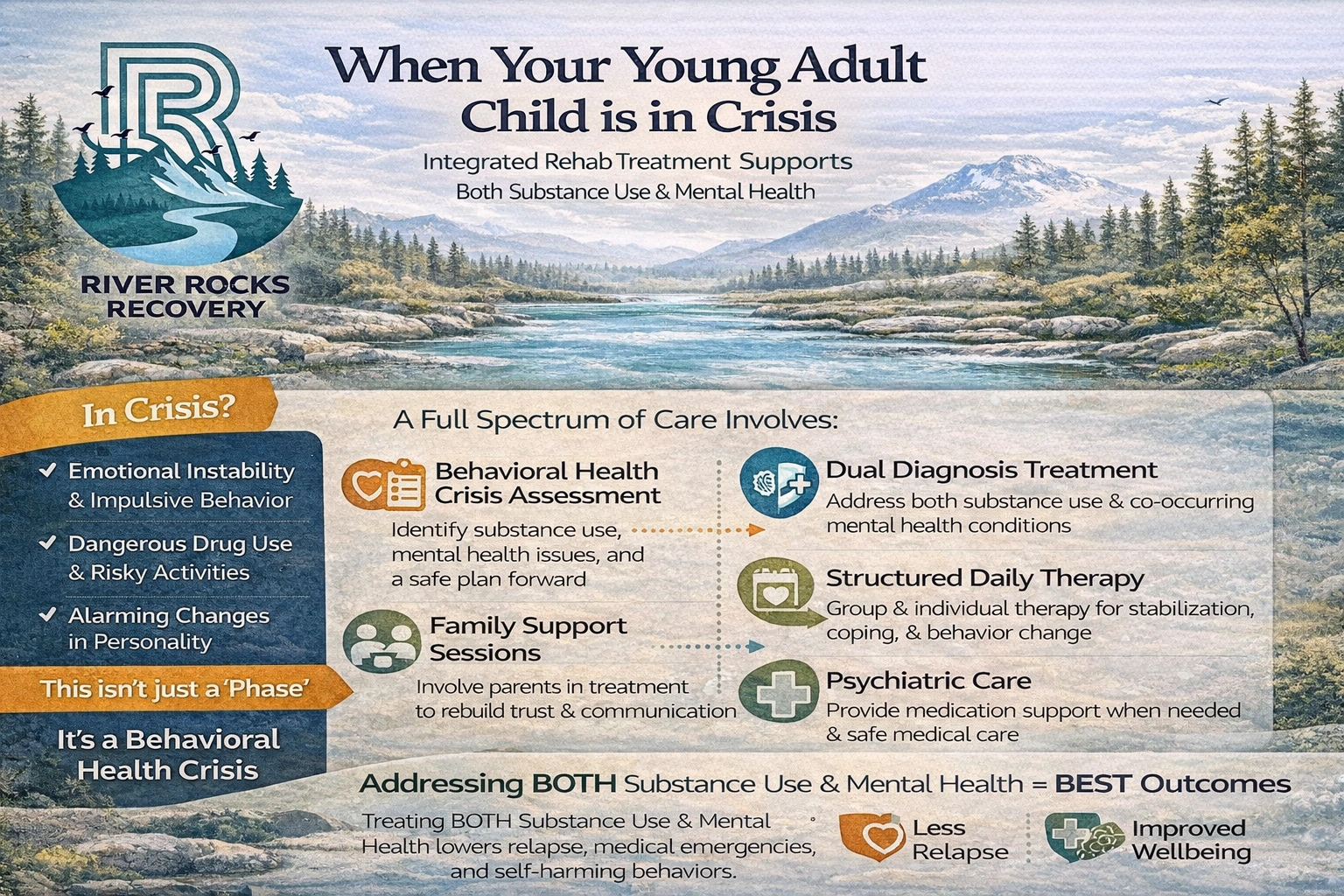
What Drug Rehab Treatment Looks Like for Crisis Clients
Drug rehab during a behavioral health crisis doesn’t look like punishment. It looks like safety, stability, and the chance to breathe.
A typical week may include:
- Daily therapeutic programming: Structured group therapy to explore feelings, behavior, and decision-making
- Individual therapy sessions: One-on-one time with a licensed therapist to process trauma, grief, anger, fear, or shame
- Psychiatric support: Medication evaluation or stabilization for conditions like bipolar disorder, major depression, or anxiety
- Psychoeducation: Teaching your child how their brain, body, and emotions work—so recovery becomes understandable, not mysterious
- Family involvement: Sessions to help you rebuild communication and trust
We also provide holistic supports like mindfulness, expressive therapy, and movement-based regulation—because the body holds crisis, too.
Crisis Doesn’t Mean “Forever”—But It Does Mean Action
Many parents feel paralyzed. They’re afraid to overreact—or underreact. But in our experience, waiting rarely leads to clarity. Crisis doesn’t often resolve itself. And early action can prevent long-term consequences.
What may start as disorientation or drug misuse can escalate into:
- Medical emergencies
- Legal involvement
- School expulsion
- Self-harm or suicidal behaviors
- Long-term psychiatric breakdown
The earlier your child receives care, the more options remain on the table. Even a few days of stabilization can make a meaningful difference in their insight, willingness to engage, and safety.
Rehab Isn’t a Sentence—It’s a Support System
Let’s be honest: the word “rehab” carries baggage. Maybe you’re picturing locked doors, harsh rules, or a total loss of freedom.
But modern drug rehab treatment—especially the kind we offer at River Rocks Recovery—is designed for partnership, not punishment.
Here’s what that looks like:
- Clients are involved in their own treatment planning
- Consent and collaboration are prioritized
- Dignity is protected, even in moments of distress
- Support is individualized—not one-size-fits-all
This isn’t about labeling your child. It’s about helping them. Many families tell us they expected resistance—and were surprised when their child relaxed into the care once they realized it wasn’t another lecture or consequence.
You Don’t Have to Leave Town to Get Help
If you’re located near Middletown, you don’t need to put your child on a plane or find a bed three states away. River Rocks Recovery offers drug rehab treatment near West Chester, Ohio and Monroe, Ohio, with a full continuum of care that keeps family nearby and involved.
We understand the urgency. We also understand the importance of familiarity and accessibility during a time of emotional chaos.
You don’t have to move mountains. You just have to take one next step.
FAQs About Drug Rehab Treatment in a Crisis Situation
What if my child is refusing treatment?
This is very common—especially in early-stage crises or when substance use is involved. We can help you assess whether a more structured intervention is needed, and offer guidance on communication, boundaries, and legal options (if safety is at risk).
Will my child be diagnosed with a mental illness?
Not necessarily—but we will evaluate thoroughly. Some clients do receive new or clarifying diagnoses, while others discover underlying issues that haven’t been named before. The goal is clarity, not labeling.
Can I still be involved if my child is over 18?
Yes. With your child’s consent (which is often granted during crisis care), you can participate in family sessions, receive updates, and be involved in planning. In cases where safety is a concern, we’ll work within legal guidelines to prioritize well-being.
How long is a typical stay?
Length of stay depends on severity, progress, and insurance factors. Crisis stabilization may be shorter (7–14 days), while ongoing care can extend to 30+ days. We’ll discuss options clearly with you at every step.
Is this a locked facility?
No. Our rehab program is structured and secure, but not locked. Clients are kept safe through therapeutic alliance, daily structure, and staff support—not through confinement.
What if I’m not sure this is “bad enough”?
If you’re losing sleep, feeling scared, or walking on eggshells around your child—that’s enough. Crisis isn’t defined by how dramatic it looks. It’s defined by risk, disconnection, and emotional instability. And those are all valid reasons to get help.
What happens after rehab?
Your child may step down into an Intensive Outpatient Program (IOP), continue weekly therapy, or join recovery groups. Some resume school or work with support. We’ll plan aftercare based on what’s actually working—not just what sounds good on paper.
You Are Not Overreacting
You’re a parent in pain. A parent trying to help. A parent caught between fear and hope.
We see you. And we want to help lighten the load.
Call (888) 905-6281 to learn more about our Drug Rehab Treatment services in Middletown, Ohio.
You don’t have to have the answers. You just have to take the next step. We’ll meet you there.