

Even if you haven’t said it out loud, the question might still be looping in your head:
“Did I just screw everything up?”
Relapsing during an Intensive Outpatient Program (IOP) can bring a tidal wave of shame, guilt, and second-guessing. Ghosting your therapist or skipping group might feel like slamming the door shut. But here’s the truth:
You’re not the first. You won’t be the last. And you’re not out.
Whether you’ve been gone a few days or a few weeks, whether you relapsed or just froze up, this blog is for you. Let’s walk through what actually happens next—and why we’ll never lead with judgment.
If you’re looking for an Intensive Outpatient Program in Middletown, Ohio, River Rocks Recovery offers support that’s structured and human. We know recovery isn’t linear. That’s why we build in room for real life.
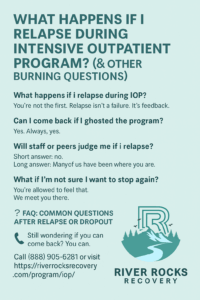
What happens if I relapse during IOP?
You’re not the first.
Relapse in IOP is common—and expected. That’s not because treatment doesn’t work, but because healing takes more than intention. It takes time, support, and a readiness that doesn’t always arrive on cue.
When relapse happens, we don’t boot you. We check in. We reassess.
- What triggered the use?
- What supports were missing?
- What might need to change in the treatment plan?
Sometimes that means staying in IOP with some added layers of support. Other times, we recommend stepping up to a higher level of care like Partial Hospitalization (PHP).
The goal isn’t punishment—it’s safety.
Relapse isn’t a failure. It’s feedback.
Can I come back if I ghosted the program?
Yes. Always, yes.
Ghosting isn’t a character flaw. It’s usually the result of shame, fear, depression, or overwhelm. Maybe you missed one group, then another, and suddenly it felt too awkward to return. That’s more common than you think.
One client told us:
“I wanted to come back sooner, but I thought I’d have to explain myself. When I finally called, they just said, ‘We’re glad you reached out.’ That was it.” – IOP Client, 2023
You don’t need a dramatic comeback story. You just need a phone call or a message. We’ll take it from there.
Will staff or peers judge me if I relapse?
Short answer: no.
Long answer: Many of us have been where you are. Some of your group peers have relapsed and come back. Some of your counselors have, too. You’ll be surprised how many people get it because they’ve lived it.
At River Rocks Recovery, judgment is not part of the care plan.
Instead, we might ask:
- How can we support you differently?
- What do you need now that you didn’t before?
- What helps you feel safe enough to try again?
We don’t lead with punishment. We lead with connection.
What if I’m not sure I want to stop again?
You’re allowed to feel that.
A lot of people come back to treatment with one foot in and one foot out. Ambivalence is part of change. In fact, pretending you’re “all in” when you’re not can actually slow progress. Understanding why some people eventually choose IOP often helps normalize that mixed motivation and makes it easier to engage with treatment honestly.
It’s okay to say:
- “I’m still using, but I want to stop.”
- “I’m not sure I’m ready, but I don’t want to keep spiraling.”
- “I don’t know what I want—but I know this isn’t it.”
We meet you there.
Because part of our job is helping you explore the questions before the answers arrive.
Is IOP even the right fit for me anymore?
Maybe. Maybe not. But you won’t have to figure that out alone.
After a relapse or a break from care, we usually do a clinical reassessment. Not to scrutinize you—but to make sure we’re giving you the level of support that actually fits your current needs.
You might stay in IOP with added supports.
You might transition to PHP or inpatient treatment.
You might restart your IOP with a slightly different group or schedule.
No matter the outcome, you’ll be involved in the plan.
If you’re coming from nearby areas like West Chester or Dayton, Ohio, we can coordinate care to minimize your commute stress or explore other local options if needed.
What if I feel too ashamed to reach out?
That’s real. But here’s a truth you can hold onto: Awkward doesn’t mean unwanted.
If you’re scared to call back, try this:
- Don’t lead with an apology.
- Just say: “Hey, I was in the program a while ago. I’m thinking about coming back. Can you tell me what that would look like?”
That’s it. That’s enough.
You don’t need a big speech or a clean slate.
You just need enough courage to make that first move.
FAQ: Common Questions After Relapse or Dropout
What if I relapsed but haven’t told anyone yet?
You can still come back. Relapse disclosure can feel heavy—start with telling one staff member you trust. We’ll support you through the rest.
Will insurance still cover my treatment if I left before?
Most likely, yes—but it depends on your plan. We’ll help you navigate insurance and explore reauthorization if needed.
Do I have to start the entire program over again?
Not necessarily. Depending on how long you’ve been gone and what’s changed, we may pick up where you left off or adapt your plan slightly. You won’t be treated like a beginner unless you want a fresh start.
Can I switch to a different group or counselor?
Yes. If your comfort level changes or if a different group might suit you better, we’ll make that adjustment.
What if I’m using again but don’t feel “out of control”?
You don’t have to hit rock bottom to seek help. If something feels off, that’s reason enough to call. You deserve support even in the gray areas.
Still wondering if you can come back? You can.
Call (888) 905-6281 or visit to explore how our Intensive Outpatient Program in Middletown, Ohio can help—whether it’s your first try, third attempt, or long-overdue return.