
You made it through the door once. That matters more than you think. If you left our intensive outpatient program (IOP) before graduation—whether after one week, one month, or just one group—you might be carrying more than stress. You might be carrying shame.
Maybe you ghosted. Maybe you used again. Maybe you didn’t even mean to stop—you just missed a few sessions and didn’t know how to come back without feeling awkward or judged.
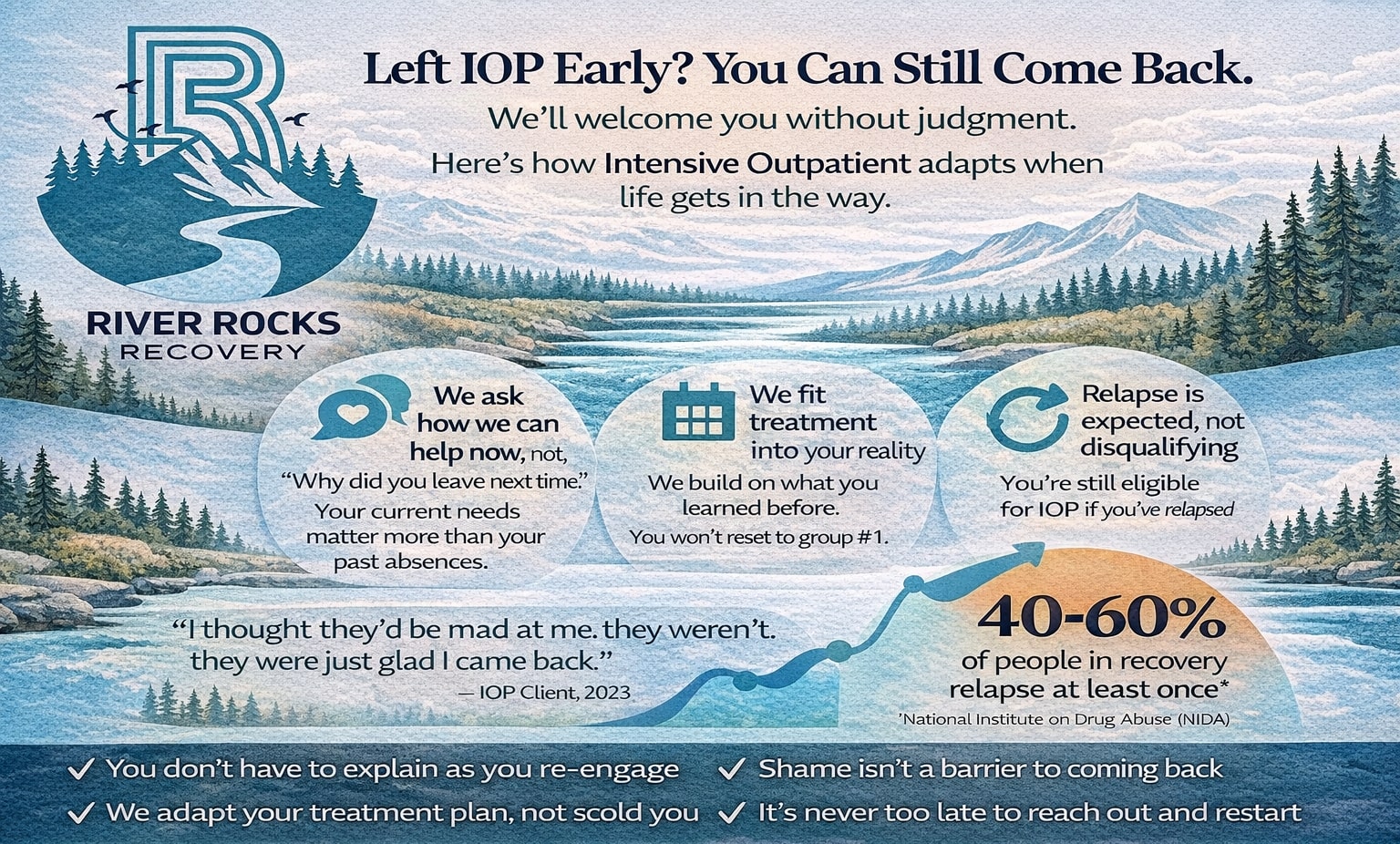
Here’s the truth: dropping out of IOP doesn’t make you a failure. It makes you human. And at River Rocks Recovery, our IOP isn’t built to punish your pauses—it’s built to adapt when you’re ready to return.
1. We Don’t Lead with “Why Did You Leave?”
There are a dozen reasons people leave IOP—and most of them aren’t about laziness or lack of commitment. Life gets messy. Trauma resurfaces. Work schedules shift. Sometimes you hit a wall emotionally, and showing up feels impossible.
When you come back (or even just call to ask if you can), we won’t lead with, “What happened?” Instead, we’ll start with:
“How can we support you now?”
Because what you need next matters more than what went wrong last time.
2. Restarting Doesn’t Mean Repeating
You won’t be forced to repeat the exact same group curriculum or start over from scratch unless that feels right to you. We don’t treat you like a reset button.
Instead, we reassess. Together, we look at:
- What worked well before?
- What felt like a mismatch?
- Were there certain group formats that triggered shutdown instead of support?
- Were you overwhelmed, under-supported, or just not ready for the structure?
We meet you with curiosity—not criticism.
3. Flexibility Isn’t a Loophole—It’s a Lifeline
Maybe your job schedule changed. Maybe childcare got complicated. Maybe your mental health dipped and you isolated instead of reaching out. You’re not the first person to need a flexible approach.
Here’s how we adjust:
- Shift your group times to mornings or evenings
- Increase 1:1 support if group work felt too vulnerable
- Coordinate with other providers if you need dual diagnosis support
- Tailor goals based on today, not your intake paperwork from last time
This is what real-world care looks like. Not perfect attendance—sustainable connection.
4. If You Relapsed, You’re Not Disqualified
We need to say this clearly: relapse doesn’t revoke your right to care.
Yes, it’s painful. Yes, it might be scary to admit. But relapse is part of the reality for many people in recovery—and it’s something we plan with, not against.
You don’t need to come in polished and abstinent. You just need to come in honest.
And if substances like meth were part of your return to use, we can help you access more targeted support in methamphetamine rehab alongside IOP.
You’re not too far gone. You’re right on time.
5. Shame Shows Up—But It Doesn’t Have to Steer
We’ve seen it a hundred times: the person who finally calls again after weeks away—but they’re whispering. Apologizing. Bracing for rejection.
You don’t need to apologize for being overwhelmed. You don’t need to overexplain. You certainly don’t need to be ashamed.
IOP is here to hold space for the whole experience of recovery—not just the parts that look good on paper.
In fact, your shame is a sign you still care. And that matters more than anything.
6. You Don’t Owe Us Perfect. Just Come Back.
We don’t need a speech. We don’t need a 30-day chip. We just need you.
That might mean:
- Logging in to one virtual group this week
- Calling a case manager to check in
- Letting us know if you’re scared to return so we can talk before your first session back
Every tiny re-entry counts. You’re not being dramatic. You’re being real.
And if your first step is just reading this blog? That counts too.
7. Treatment Plans Can—and Should—Change
The same way a therapist adjusts techniques if you’re not responding, an IOP should adapt to your real-time needs. At River Rocks Recovery, we treat your plan like a living document.
That means:
- Rewriting goals based on new insights
- Adding trauma-informed therapy if past events are resurfacing
- Pausing group if individual work is more important right now
You’re not signing a contract. You’re starting a collaboration.
8. The Door Was Never Closed
Maybe you told yourself you couldn’t come back. That it would be weird. That we’d roll our eyes or say “You had your chance.”
That’s not how we work. We know recovery is a process—not a straight line.
If you’re wondering whether you’re still welcome, here’s your answer:
Yes. Always.
What Clients Say After Returning
“I thought they’d be mad at me. They weren’t. They were just glad I came back.”
– IOP Client, 2023
“The second time I did IOP, it actually stuck. I wasn’t pretending anymore.”
– Returning Client, 2022
Frequently Asked Questions
Can I come back if I left without telling anyone?
Yes. You don’t have to explain everything. Just reach out. We’ll meet you with compassion, not criticism.
Will I have to start over completely?
Not unless you want to. We’ll revisit your plan together and focus on what’s most helpful for where you are now.
What if I used again while I was gone?
You’re not alone. Many people return to treatment after a relapse. We can help you process what happened—and move forward safely.
Will my old spot still be available?
It depends on current capacity, but we’ll work to get you into the next available group or session. We’ll do everything we can to get you reconnected quickly.
I’m embarrassed. Can we talk privately first?
Absolutely. You can call and ask to speak to a clinician or case manager before rejoining. We’ll help make the return feel safe and manageable.
Looking for addiction treatment options in Ohio?
If meth or stimulant use is part of your experience, we can help you access specialized support in methamphetamine rehab. You’re not stuck with a one-size-fits-all plan—we tailor care to match your actual needs.
Call (888) 905-6281 or visit to learn more about our intensive outpatient program services in Middletown, Ohio. We’re here when you’re ready. And we mean it. No shame. Explore our services and discover safe ways to process your memories. Recovery in West Chester, Hamilton, Monroe, and Dayton begins with support that truly understands. No judgment. Just support.