


I remember walking out feeling steady. Clear-headed. Almost proud.
Not “fixed,” but finally… okay.
And then, slowly—quietly—I wasn’t.
If you’ve been there, if you’ve felt that confusing pull back into old habits after doing real work… you’re not broken. You’re not the exception.
You’re human.
I Thought Strength Meant I Could Handle Anything
There’s a moment after treatment that feels almost like relief mixed with confidence.
You’ve done the work. You’ve sat in the uncomfortable conversations. You’ve learned things about yourself you can’t unlearn.
So it makes sense that your brain says:
“I’ve got this now.”
I told myself that too.
But strength in a supported environment and strength in real life aren’t always the same thing.
One is practiced. The other is tested.
And no one really prepares you for how different that feels.
The World Didn’t Slow Down Just Because I Needed It To
When I stepped back into daily life, everything came at once.
Responsibilities didn’t wait. Stress didn’t soften. Relationships picked up right where they left off.
In structured daytime care, there was space—space to think, to process, to pause before reacting.
Out here, it felt like I had to respond instantly.
And when you don’t pause, you fall back on what’s familiar.
Even if it’s the very thing you were trying to change.
The Shift Was Subtle Before It Was Obvious
Relapse didn’t show up as a big, dramatic moment.
It started small.
A thought I didn’t challenge.
A feeling I didn’t talk about.
A boundary I quietly let slide.
At first, it didn’t seem like a big deal.
But those small moments? They stack.
Like water slowly filling a room—you don’t notice until it’s at your knees.
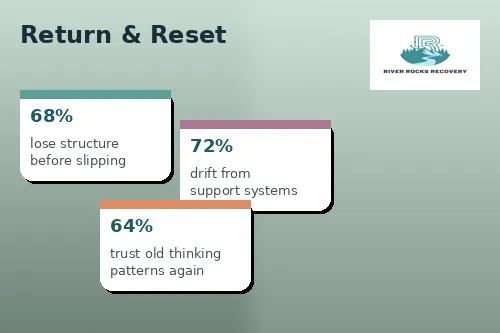
I Started Trusting My Old Logic Again
This part is hard to admit, but it matters.
I started believing my old thoughts again.
- “I can handle this differently now.”
- “I’ve learned enough to control it.”
- “This time will be different.”
It didn’t feel reckless. It felt reasonable.
That’s what makes it dangerous.
Because relapse doesn’t always come from chaos—it often comes from quiet confidence in the wrong direction.
I Didn’t Stay Connected to What Helped Me
If I’m honest, I didn’t lose everything.
I didn’t forget what I learned. I didn’t erase the progress.
But I drifted away from the things that kept me grounded.
I stopped showing up the same way.
I stopped checking in.
I stopped being honest about how I was actually doing.
That disconnection? That’s where things really shifted.
Not overnight. But steadily.
I Didn’t Understand How Much Structure I Still Needed
This was the turning point for me.
I thought I had “graduated” from needing support.
But what I actually needed… was a different level of it.
There’s a big gap between round-the-clock support and doing everything on your own.
And in the middle, there’s something that often gets overlooked—structured daytime care.
If you’ve ever searched partial hospitalization vs inpatient, you’re probably trying to understand that same gap.
It’s not about choosing the “right” one forever.
It’s about recognizing what you need right now.
For me, I stepped out of support too quickly—and underestimated how much that middle layer was holding me up.
If you’re questioning that for yourself, it might help to look at structured daytime care again—not as a step backward, but as a bridge forward.
I Thought Going Back Meant I Failed
This belief kept me stuck longer than anything else.
Going back felt like admitting I had messed everything up.
Like I had wasted the work. Like I didn’t deserve another chance to try again.
But here’s what I see now:
Going back meant I noticed something was off.
Going back meant I remembered what helped.
Going back meant I chose not to disappear.
That’s not failure.
That’s awareness with action.
The Shame Was Louder Than the Truth
After slipping, the loudest voice in my head wasn’t logic—it was shame.
It said:
- “You should know better.”
- “You already had your chance.”
- “People are going to see right through you.”
And shame has a way of making you isolate.
But isolation is exactly where old habits grow stronger.
The truth—quieter, but still there—was this:
I didn’t need to prove anything. I just needed support again.
I Compared My Struggle to Everyone Else’s
I looked around and thought:
“Why can they handle this and I can’t?”
That comparison kept me stuck.
Because it made asking for help feel like weakness instead of awareness.
But here’s what I’ve learned since:
Everyone’s threshold is different.
Everyone’s path is different.
And everyone’s support needs change over time.
What worked for someone else doesn’t define what you need.
I Needed a Bridge, Not a Leap
If I could describe what went wrong in one sentence, it would be this:
I tried to leap when I needed a bridge.
Structured daytime support had been that bridge.
It gave me stability while still letting me live my life.
And when I removed it too quickly, I felt it.
If you’re in that space right now—caught between needing support and wanting independence—you’re not alone in that tension.
For people in areas like West Chester, Ohio, having access to flexible care options can make that bridge feel possible again—without uprooting everything.
What I’d Say to You If You’re in This Moment
If you’re reading this after slipping back into old habits, I want you to hear this clearly:
You didn’t erase your progress.
You didn’t undo everything.
You didn’t fail in the way you think you did.
You learned something about what you need.
And that matters.
You Can Rebuild Without Starting Over
There’s this idea that relapse sends you back to the beginning.
But that’s not true.
You’re not starting from scratch—you’re starting from experience.
You know what helped before.
You know what didn’t.
You know where things started to shift.
That awareness? That’s powerful.
And it makes your next step stronger—not weaker.
There Are Still Options That Meet You Where You Are
You don’t have to go from zero to extreme.
There are ways to ease back into support that feel manageable.
Ways that allow you to:
- Stay connected to your life
- Rebuild structure gradually
- Get support without feeling overwhelmed
For some, that also includes exploring layered care—like treatment options in Methamphetamine Rehab alongside structured programs, depending on what they’re navigating.
It’s not about choosing one path forever.
It’s about choosing what helps right now.
FAQs About Slipping After Treatment
Is relapse a sign that treatment didn’t work?
No. Relapse often highlights where more support or a different level of care is needed. It doesn’t erase the progress you made.
Why did I feel strong at first but struggle later?
Because early strength is often supported by structure. When that structure changes, new challenges appear. That’s normal.
Does going back to support mean starting over?
Not at all. You’re returning with more awareness, more insight, and more clarity than before.
How do I know what level of support I need now?
If things feel unstable, it might mean you need more structure again—but not necessarily the highest level. A middle ground can often help.
What if I feel ashamed to reach out again?
That feeling is common—but it’s also the thing that keeps people stuck. Reaching out is a step forward, not backward.
You’re Not Back at the Beginning—You’re at a Decision Point
This moment right here?
It’s not the end of your progress.
It’s a decision point.
You can ignore it. Push it down. Try to power through.
Or…
You can listen to it.
That quiet voice that says:
“Something isn’t working. And I don’t want to keep going like this.”
That voice isn’t weakness.
It’s awareness.
Ready to Take a Step That Feels Supportive Again?
You don’t have to commit to everything today.
You don’t have to prove anything.
You just have to take one step that feels more supportive than staying stuck.
Call (888) 905-6281 or visit our Partial Hospitalization Program in Middletown, Ohio to learn more about your options and what a flexible, supportive path forward can look like.