

You saw them try.
You watched them work hard in recovery. You listened to the therapy language. You believed the relief in their voice when they said they were doing better.
And now they’re drinking again.
If you’re reading this, you may feel like the floor dropped out from under you. As a clinician, I want to tell you something clearly and gently:
Relapse is serious.
But it is not proof that nothing worked.
When parents begin searching again for alcohol addiction treatment, it’s rarely because they’re uninformed. It’s because they’re scared — and they love their child enough to keep trying.
Let’s talk honestly about what relapse means — and why treatment still matters deeply.
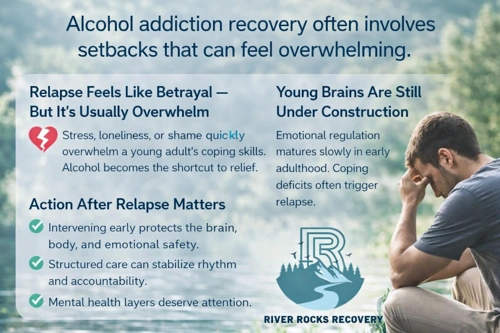
Relapse Feels Like Betrayal — But It’s Usually Overwhelm
The first time your child entered recovery, there may have been chaos.
This time feels different.
This time you’re thinking:
- “They knew better.”
- “They had the tools.”
- “Why would they risk this again?”
Here’s the hard truth: relapse is rarely about ignorance.
It’s about emotional overload.
Young adults often relapse when stress, loneliness, shame, or mental health symptoms exceed their current coping capacity. Alcohol works quickly. It lowers anxiety fast. It numbs pain immediately.
That doesn’t mean they didn’t learn anything.
It means the distress outpaced their skills.
Young Brains Are Still Under Construction
At 20, your child looks grown.
Neurologically, they are still developing.
The part of the brain responsible for impulse control, long-term planning, and emotional regulation continues maturing into the mid-20s. When stress spikes, that developing brain can default to familiar relief patterns.
Alcohol becomes a shortcut.
That doesn’t excuse the behavior. But it does explain vulnerability.
When I speak with families in Hamilton, Ohio, I often remind them that early adulthood is one of the most neurologically fragile seasons for addiction risk. That’s why structured support matters more — not less — after a relapse.
The Shame Spiral Is Powerful
Relapse doesn’t just restart drinking.
It often restarts shame.
Your child may now be thinking:
“I ruined everything.”
“They’re disappointed again.”
“What’s the point of trying?”
Shame is fuel for addiction. It pushes people back into secrecy. It convinces them they’ve failed beyond repair.
If relapse is met only with anger or despair, that shame deepens.
But if it’s met with firm, steady concern and a path forward, it can become a turning point.
The Hard Truth: Relapse Is a Risk — But So Is Waiting
Here’s what I won’t soften:
Relapse increases danger.
Tolerance can escalate quickly. Risk-taking may rise. The body is under renewed stress. Decision-making may become less stable.
Waiting to see if it “levels out” often gives addiction more room to grow.
Intervening early after relapse protects:
- Brain function
- Physical health
- Academic or career stability
- Emotional safety
Action after relapse is not overreacting.
It’s protective.
Treatment the Second Time Is Not the Same as the First
Parents often ask:
“Why would we send them back if it didn’t work?”
Because relapse gives us information.
It shows us:
- What triggers weren’t fully addressed
- Whether mental health care was deep enough
- If structure ended too quickly
- Where support systems weakened
The second round of care is rarely identical to the first. Treatment plans adjust. Structure may be extended. Mental health layers may be prioritized more intentionally.
Alcohol addiction treatment builds on what your child already learned. Even if it doesn’t look like it right now, those tools are not erased.
They may just be buried under distress.
When Mental Health Was the Missing Piece
Many young adults relapse not because they crave alcohol more — but because anxiety, depression, trauma, or mood instability resurfaced.
When mental health and substance use collide, alcohol becomes relief.
If the emotional foundation isn’t stabilized, sobriety can feel fragile.
Comprehensive care matters. In some cases, if other substances are present, families may also explore broader stabilization through treatment options in Methamphetamine Rehab.
This isn’t about assuming the worst.
It’s about making sure nothing is overlooked.
Families in Monroe, Ohio often express fear that returning to treatment means starting from zero. In reality, it means refining the plan based on new data.
What Parents Can Do Right Now
You cannot control your child’s choices.
But you can influence the environment around them.
You can:
- Stay calm during conversations
- Express fear without accusation
- Set clear boundaries about safety
- Encourage professional reassessment
- Seek support for yourself
Tone matters.
“I’m scared for you” lands differently than “How could you do this again?”
Your steadiness can interrupt the shame spiral.
This Is Not a Parenting Failure
Relapse tempts parents to blame themselves.
“Did we miss signs?”
“Were we too lenient?”
“Did we trust too quickly?”
Addiction is influenced by genetics, brain chemistry, trauma exposure, social environment, and mental health — not a single parenting choice.
Blame drains energy you need for action.
You didn’t cause this relapse.
But you can help respond to it.
The Hope That Still Exists
I have worked with many young adults who relapsed once — or more — and still built stable, meaningful recovery.
What changed wasn’t perfection.
It was persistence.
Relapse can become the moment your child recognizes that moderation isn’t working. That white-knuckling isn’t sustainable. That deeper support is necessary.
Sometimes relapse clarifies what denial kept hidden.
And clarity can be powerful.
The Role of Structure After Relapse
After a relapse, unstructured time can be risky.
Idle hours increase vulnerability. Isolation amplifies shame.
Structured daytime care or multi-day weekly treatment can reintroduce rhythm and accountability.
Consistency protects.
Routine lowers stress hormones. Predictability reduces impulsivity. Community counters isolation.
This isn’t about punishment.
It’s about scaffolding while healing stabilizes.
Frequently Asked Questions Parents Ask After Relapse
Does relapse mean treatment failed?
No. Relapse provides insight into what additional support may be needed. Treatment is a process, not a single event.
Is it common for young adults to relapse?
Yes. Early recovery can be fragile, particularly when emotional regulation skills are still developing.
Should we act immediately?
If safety is at risk, yes. Otherwise, scheduling a reassessment quickly is wise. Waiting often increases risk.
What if they refuse to go back?
Resistance is common. Stay consistent. Avoid threats unless necessary for safety. Professional guidance can help you approach the conversation strategically.
Are we enabling by helping again?
Supporting treatment is not enabling. Enabling protects addiction from consequences. Treatment protects your child from harm.
Can relapse actually strengthen recovery?
In some cases, yes. When addressed properly, relapse can deepen insight and commitment.
You’re Allowed to Be Both Angry and Hopeful
You can feel furious and heartbroken at the same time.
You can feel tired and still choose action.
You can question everything and still believe change is possible.
Relapse is painful.
But it is not a verdict.
It is a signal.
And signals are meant to be answered.
What Happens Next Matters
The days after relapse are critical.
Shame can take over. Or structure can step in.
Silence can grow. Or conversation can open.
Isolation can deepen. Or support can expand.
You cannot rewrite what happened.
But you can influence what happens next.
If you’re ready to talk about what that next step looks like — calmly, clearly, without blame — we’re here to walk with you.
Call (888) 905-6281 to learn more about our alcohol addiction treatment in Middletown, Ohio.