
I remember my last day in the partial hospitalization program at River Rocks Recovery. The staff clapped, my peers hugged me, and I walked out with a folder full of resources and a plan in hand. It felt like an ending—maybe even a victory.
But three months later, I found myself sitting on my couch, numb. Not drinking. Not using. Not thriving.
I didn’t relapse. I didn’t fall apart. I just… flattened. And in that hollow space, I had to face a harder truth: PHP wasn’t the end of my story. It was the middle.
Finishing a Program Doesn’t Mean You’re “Done”
There’s a subtle pressure in recovery—this unspoken idea that after treatment, you’re supposed to “have it together.” Especially if you’ve been sober a while. You might hear things like:
- “You’re doing great!”
- “Keep it up!”
- “You’ve come so far!”
And those things might be true. But they can also silence the part of you that feels emotionally off or spiritually disconnected.
I didn’t know how to talk about that flatness at first. It wasn’t depression, exactly. It was more like… recovery without resonance. And that made me question whether I was doing something wrong.
PHP Gave Me Tools—But Not a Finished Product
Looking back, I see my time in PHP as a foundation. I learned how to regulate my emotions, manage triggers, and structure my day. I got space from the chaos of early sobriety and started rebuilding trust in myself.
But PHP wasn’t a magic fix. It wasn’t supposed to be.
It gave me tools. What it didn’t do—what it couldn’t do—was guarantee that I’d always know how to use them in the messy, slow-burning middle of life after treatment.
I Thought I Was Just “Blah”—Turns Out I Was Disconnected
The emotional flatness I felt wasn’t a sign of failure. It was a sign of disconnection. I’d lost touch with the things that made me feel alive—connection, purpose, real community.
In PHP, we talked every day. We shared real things. We cried in groups and laughed in between therapy sessions. That depth? That aliveness? I missed it.
I didn’t know how much I needed community until it was gone.
And I didn’t know how to ask for it back—because I thought I wasn’t allowed to need it anymore.
Reaching Back Isn’t Weakness. It’s Wisdom.
For a while, I hesitated to reconnect with formal support. I told myself, “You’re supposed to be past this.” But the truth is, long-term recovery isn’t about powering through. It’s about staying honest.
So I called River Rocks again. Not to “start over,” but to check in. I joined a virtual alumni group. I reconnected with my therapist. And just like that, the color started to return.
Asking for support again wasn’t a regression—it was a re-engagement.
What I Didn’t Know Then About Long-Term Sobriety
No one told me that long-term sobriety can get quiet in a way that’s hard to describe. That the early chaos fades—and sometimes, so does the intensity that kept you focused.
Without the constant crisis, you’re left with your real life. And real life is messy, boring, beautiful, stressful, and deeply human.
It’s okay to miss the intensity of early recovery. It’s okay to feel emotionally off—even years in. What matters is not pretending you’re fine when you’re not.
PHP Isn’t Just for the Beginning
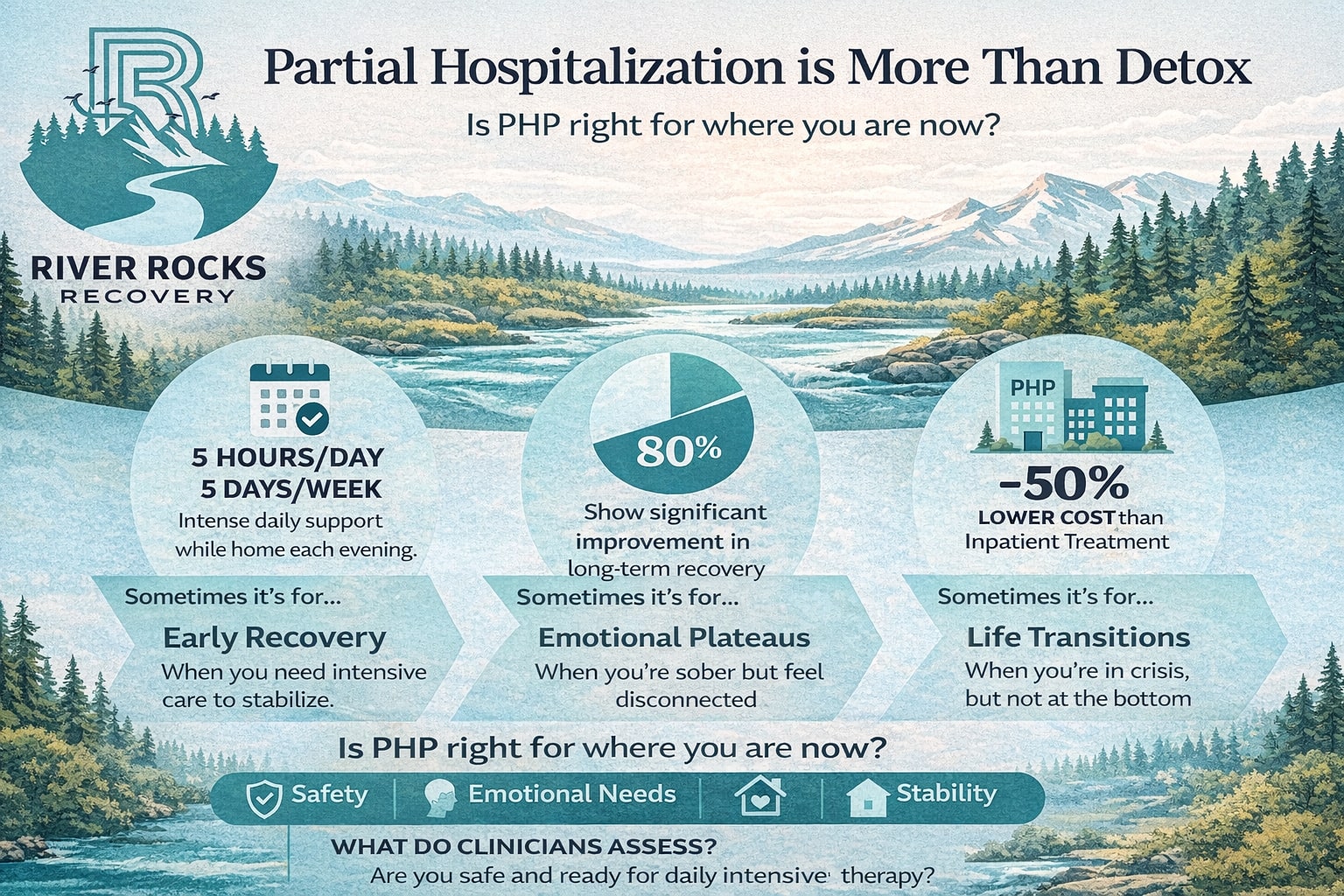
One of the biggest things I’ve learned is that a partial hospitalization program isn’t just for people at rock bottom. It’s also for people who are sober, but stuck. People who want more than maintenance mode.
If that’s you, it doesn’t mean you’re failing. It means you’re ready for more depth, more clarity, more life.
And programs like PHP are built to help you find that—not as a restart, but as a recommitment.
Real Talk from Alumni
“I didn’t need rehab again. I needed to feel something again. PHP helped me remember who I am—underneath the routine, the sobriety chips, the ‘you’re doing greats.’”
– Alumni Client, 2023
That quote? That could’ve been me. And maybe it’s you too.
When Treatment Becomes a Chapter, Not Just a Step
Treatment isn’t a pit stop on the way to a perfect life. It’s a chapter—a big one. But life continues after the program ends.
And when that next chapter feels empty or disorienting, you’re not broken. You’re just being invited into deeper work. Into integration. Into reconnection.
Maybe PHP was your beginning. Or maybe it’s time for it to be your middle.
FAQ: Partial Hospitalization Program & Long-Term Recovery
What is a partial hospitalization program (PHP)?
A PHP is a structured, therapeutic treatment program that provides intensive support during the day while allowing you to return home at night. It’s more flexible than inpatient rehab but offers more structure than standard outpatient care.
Is PHP just for people new to recovery?
Not at all. PHP can be powerful for people early in recovery and for those further along who feel emotionally flat, disconnected, or stuck. Think of it as a space to re-ground and go deeper—not just detox.
Can I re-enter a PHP if I’ve already completed one?
Yes. Many people benefit from returning to structured support during challenging life phases, emotional plateaus, or periods of transition. It’s not about starting over—it’s about getting the right support for where you are now.
How is PHP different from IOP?
A Partial Hospitalization Program typically involves more hours per week than an Intensive Outpatient Program (IOP) and may include medical monitoring. PHP is ideal for those who need a higher level of structure but not 24/7 care.
Will going back to treatment mean I’ve failed?
Not at all. Reconnecting with support—whether through alumni services, therapy, or another round of PHP—is a strength move. It shows awareness and willingness to stay engaged in your growth.
You Don’t Have to Stay Disconnected
You don’t need to hit bottom to want more from your recovery. If your sobriety feels like it’s missing something, maybe it’s time to reengage—not out of crisis, but out of curiosity and care.
Want to reconnect with something deeper?
Call (888) 905-6281 or visit to learn more about our partial hospitalization program services in Middletown, Ohio.